

Wildland Caves
Caves are some of the most fragile ecosystems in the Texas Hill Country. Light is limited and the air is still. Our caves are protected with great care on behalf of the fragile life within them. Animal adaptations in caves range from oversized pincers for feeling around in the dark to a complete lack of eyes. In Central Texas, caves are often the connecting link between the Edwards Aquifer and the surface.
Special Cave Creatures
All six karst invertebrates protected under the Balcones Canyonlands Conservation Plan were listed as endangered in September 1988 and live in only a few local caves. Though not much is known about them, they share some traits in common. As invertebrates, they lack an internal skeleton — instead, they have a rigid exterior called an exoskeleton that provides structure and form. They are all troglobites, a term for animals so completely adapted to cave life that they spend their entire life cycle underground, often losing pigmentation and functional eyes entirely.
The primary threat to these cave-obligate species is urban development. Caves filled in or paved over lose habitat entirely. Creating new openings or altering drainage can change cave temperature and humidity beyond what the species can tolerate. Urban development also introduces pesticides, fertilizers, roadway runoff and other chemicals that seep through soil and porous limestone to contaminate caves and groundwater.
Tooth Cave Ground Beetle (Rhadine persephone)
At about ¼ inch long, this tiny reddish-brown beetle is the largest of the six protected karst invertebrates. It possesses very small eyes despite living its entire life in a cave. It runs rapidly across cave floors searching for tiny insects or digs through deep loose silt hunting for cave cricket eggs. It has been documented in nearly 30 local caves.
Tooth Cave Pseudoscorpion (Tartarocreagris texana)
The second smallest of the protected cave invertebrates at 3/16 inch long, this creature resembles a scorpion and uses tiny pincers to catch small invertebrate prey. It has no tail and no eyes and is typically found under rocks. Little is known about its habits or reproductive patterns.
Tooth Cave Spider (Tayshaneta myopica)
At 1/16 inch long, this pale cream-colored spider is the smallest of the six protected cave invertebrates. It has relatively long legs and rudimentary eyes. It hangs from small tangle or sheet webs on cave ceilings and walls, where it feeds on tiny invertebrates.
Bee Creek Cave Harvestman (Texella reddelli)
This light yellowish-brown invertebrate averages 1/8 inch long with the long legs typical of most harvestman. It lives in total darkness under rocks and has no eyes. Unlike spiders, it builds no web — instead it catches its prey of tiny insects while moving slowly through the cave.
Bone Cave Harvestman (Texella reyesi)
This long-legged harvestman is less than 1/8 inch long, pale orange-brown and blind, feeding on tiny invertebrates under rocks. Studies have found this species is especially sensitive to low humidity and retreats to the coolest and most moist parts of a cave during hot summers.
Kretschmarr Cave Mold Beetle (Texamaurops reddelli)
This tiny dark-brown beetle is less than 1/8 inch long. It has short wings, long legs and no eyes and lives in total darkness under rocks and organic debris that has washed into the cave. Very little is known about this species, including its diet.
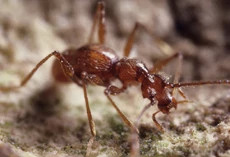
Kretschmarr Cave mold beetle (Texamaurops reddelli) |
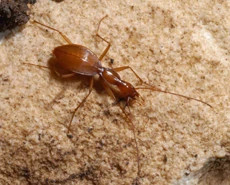
Tooth Cave Ground Beetle (Rhadine persephone) |
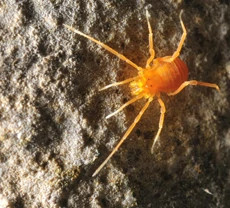
Bone Cave Harvestman (Texella reyesi) |
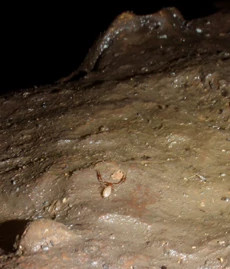
Tooth Cave Pseudoscorpion (Tartarocreagris texana) |
Airmen's Cave
Airmen's Cave was discovered in March 1971 by two airmen stationed at Bergstrom Air Force Base, who began excavation at the entrance. Later that year, an Air Force captain and local cavers returned to explore the cave and create a map.
The cave is home to raccoons, tri-colored bats, cave crickets, spiders, millipedes and scorpions.
Cave Access
The cave was open to public exploration for many years. Following multiple rescues of lost visitors and documented illegal activity, the cave was closed to the public to protect its ecological integrity and the safety of visitors.
To request access, email the cave manager.