

The Environmental Vector Control program provides education, information and ideas on techniques that can be used by individual property owners to mitigate or eradicate mosquitoes and rodents on their property.
- Mosquitoes
-
Mosquitoes may harbor several diseases that contribute to outbreaks of Zika, West Nile, dengue fever, encephalitis and canine heartworm.
Effective mosquito control helps to control mosquito populations to prevent or reduce these outbreaks and enhance the enjoyment of outdoor activities by everyone in the community.
- To report a mosquito problem, call 3-1-1 or complete a Service Request online.
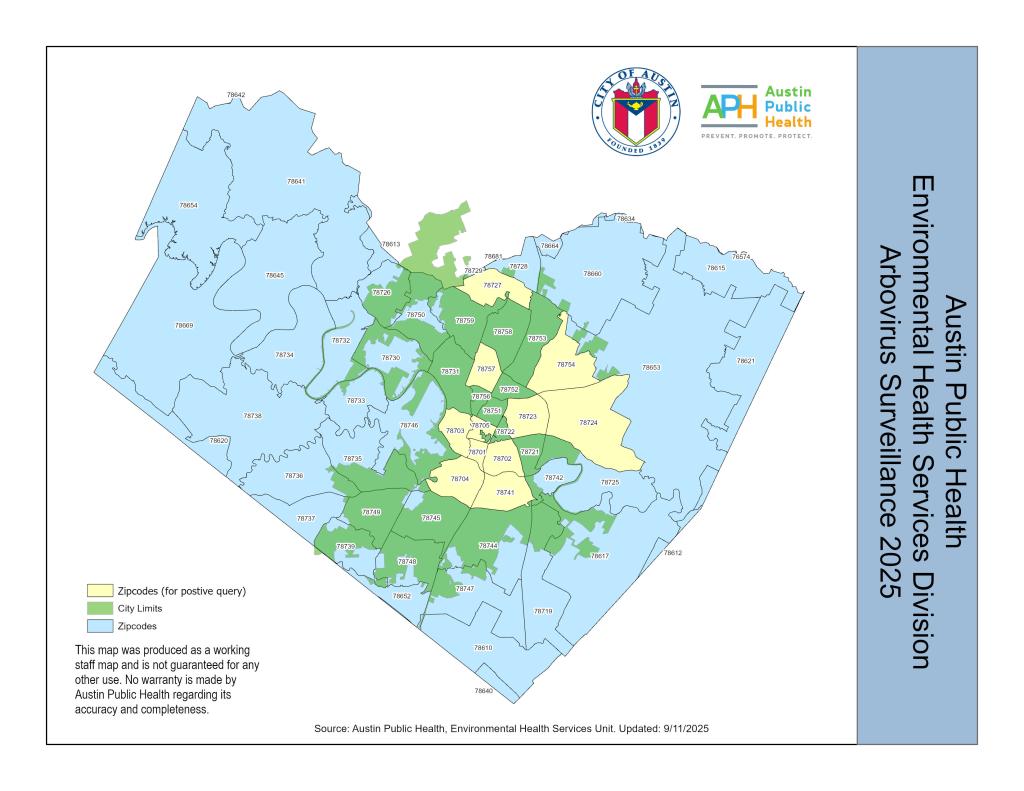
Attention: In 2025, mosquito pools (group of mosquitos collected) which have tested positive for West Nile Virus have been found in 78701, 78702, 78703, 78704, 78706, 78723, 78724, 78727, 78730, 78733, 78741, 78754, 78757, and 78758. APH Environmental Health Services Division is increasing surveillance activities and posting awareness signs/flyers in those areas.
Arbovirus Surveillance Map:
Mosquitoes are present in Central Texas year-round, but the population is largest and most active from May through November. During this period, Austin Public Health monitors the population and tests for mosquito-borne viruses. Those that carry West Nile Virus (WNV) are of particular concern.
Here are a few things you can do to protect yourself from mosquitoes.
Drain standing water.
Mosquitoes grow in standing water. They breed fast – in just a few days, they can lay hundreds of eggs. Once a week, empty and scrub, turn over, cover or throw out containers that hold water, including:
- Tires
- Pet water bowls
- Containers and buckets
- Planters
- Toys
- Birdbaths
- Flowerpot saucers
- Trash containers
- Rain barrels
Protect yourself by applying insect repellent.
Use Environmental Protection Agency (EPA)-registered insect repellents with one of the active ingredients below. When used as directed, EPA-registered insect repellents are proven to be safe and effective, even for pregnant and breastfeeding people. Repellents include:
- DEET
- Picaridin (known as KBR 3023 and icaridin outside the US)
- IR3535
- Oil of lemon eucalyptus (OLE)
- Para-menthane-diol (PMD)
- 2-undecanone
- Find the right insect repellent for you by using the EPA’s search tool.
Dress to Protect
Wear long pants and long sleeves when you’re outside, especially in places with high mosquito activity.
Mosquito Guides

- Mosquito Prevention
-
Mosquitoes are among the most important insect pests affecting the health of people. They are not just annoying; they can also transmit many diseases. A rainy spring proceeded by a mild winter, can lead to an active mosquito season.
Mosquitoes are present in Central Texas year-round, but the population is largest and most active from May through November. During this period, Austin Public Health monitors the population and tests for mosquito-borne viruses. Those that carry West Nile Virus (WNV) are of particular concern. In 2023 one West Nile virus death and three probable West Nile virus cases were reported in Austin-Travis County.
Symptoms
Most people who are infected with the West Nile Virus will not get sick. However, it is estimated that 20% of people who become infected will develop West Nile fever with mild flu-like symptoms, including fever, headache and body aches, a skin rash on the trunk of the body, and swollen lymph glands.
About one in 150 people infected with WNV will develop severe illness. Those older than 50 are at higher risk for severe disease. The severe symptoms can include high fever, headache, neck stiffness, stupor, disorientation, coma, tremors, convulsions, muscle weakness, vision loss, numbness, and paralysis.
Symptoms can last for as short as a few days, or may last several weeks, and neurological effects may be permanent. Read more about symptoms from the Centers for Disease Control and Prevention (CDC).
Prevention
The most important way to prevent WNV is to reduce the number of mosquitos where people work and play. Mosquitoes can only breed in standing water, and it can be in as little as one teaspoon. By draining all sources of standing water in and around your property, you reduce the number of places mosquitoes can lay their eggs and breed.
Using insect repellents and wearing protective clothing is the best way to prevent getting bitten by mosquitoes.
Fight the Bite Day and Night with the Four Ds:
- Dusk and dawn: Although different species of mosquitos are active at different times of day, the species that spread West Nile Virus are most active between dusk and dawn.
- Dress: Wear pants and long sleeves when you are outside. Wear light-colored, loose-fitting clothing; mosquito repellent clothing is also available
- DEET: Apply insect repellent that contains DEET. Read and follow label instructions. Spray both exposed skin and clothing with repellent.
- Drain: Get rid of standing water in your yard and neighborhood. Old tires, flowerpots, clogged rain gutters, birdbaths and wading pools can be breeding sites for mosquitos.
Ways to eliminate mosquito breeding sites:
- Reduce standing water around your home and neighborhood (including plant saucers, toys, buckets, and clogged gutters)
- Replace water at least once a week in pet dishes and birdbaths
- Repair leaky faucets and pipes
- Keep window and door screens in good repair
- Carefully screen rainwater harvesting cisterns to exclude mosquitos
- Use “mosquito dunks” (Bacillus thuringiensis israeliensis) to reduce mosquitos in rain barrels and permanent bodies of water. These products slowly release a biological larvicide that kills the pest
Helpful Links
- Fight the Bite Toolkit
- Austin Public Health Environmental Vector (Mosquito) Control Program
- Earth Wise Guide to Mosquitos
- West Nile Virus: What you need to know, (Center for Disease Control and Prevention)
- West Nile Virus in Texas (Texas Department of State Health Services)
- Mosquitos and the Diseases They Transmit (Texas Cooperative Extension Service)
- To report a mosquito problem, call 3-1-1 or complete a Service Request online.
- Rodents
-
Rodents, particularly rats, are responsible for a substantial amount of property damage and may transmit diseases, such as Murine typhus, plague, salmonellosis, trichinosis, leptospirosis, and rat-bite fever.
Code violations: Code violations such as tall weeds/grass, trash, or debris, may contribute to a rodent problem.
- To report violations call us at 3-1-1 or online.
- Bees and Stinging Insects
-
City Ordinance Chapter 3-6 regulates the maintenance and management of bee colonies within Austin city limits. Chapter 3-6 does not apply to wild colonies that have established themselves in naturally protected places, such as tree hollows, tree stumps, or any other location uncharacteristic of conventional beekeeping activity.
The City of Austin does not provide services for the removal, relocation, or eradication of bees due to State regulations related to bees. The City of Austin does not provide a referral list for providers of bee services and is not affiliated with any one provider. However, the City of Austin advocates the removal and relocation of bees in lieu of eradication whenever possible.- To report a Bee Ordinance violation contact 3-1-1 or visit 3-1-1 online
- For information about bee behavior or to request bee removal services, please visit the Texas Apiary Inspection Service.
- Bats
-
Austin houses the largest urban bat colony in North America. While bats contribute greatly to our ecosystem, it is important to be safe when encountering them.
For information about potential rabies exposure see Austin Public Health's Rabies Exposure Information
Help us better serve our customers by providing feedback through our online survey.