

Local Historic Districts

What is a local historic district?
A local historic district is an area that shares common themes, history, and/or architecture. Historic districts help preserve Austin’s diverse heritage and culture and further other community goals such as affordability and neighborhood stability. Local historic districts offer the strongest protection for distinctive older neighborhoods.
Austin has eight local historic districts. View the districts using the Historic Property Viewer and explore the Austin’s Local Historic Districts section at the bottom of this page for more information on each district.
Local Historic District FAQs
Contributing and Noncontributing Properties
In local historic districts, regulations and available incentives depend on whether your property is contributing or noncontributing. This status is determined during the historic district designation process. Check your property’s status in the Historic Property Viewer.
- Contributing properties: Buildings, structures, or sites that are at least 50 years old, were built during the district’s period of significance, and retain a high degree of integrity.
- Noncontributing properties: Buildings, structures, or sites that are under 50 years old, were built outside the district’s period of significance, and/or do not retain integrity.
Benefits and Responsibilities
Owning property in a historic district comes with benefits and responsibilities.
Project Review:
- Exterior site and building changes to contributing properties require review and approval by the Historic Preservation Office or Historic Landmark Commission, with the exception of routine maintenance and in-kind repairs.
- All ground-up, standalone construction within the district requires review and approval by the Historic Landmark Commission. This includes new construction on both contributing and noncontributing properties.
- Projects must comply with the historic design standards for the district. To view historic design standards for a district, expand the accordion boxes in the Austin's Local Historic Districts section below.
- Learn more about historic review.
Tax Incentive:
If you rehabilitate a contributing property in a historic district, you are eligible for a City of Austin tax abatement.
- 100% of City property taxes on the value added from the rehabilitation are abated for 7 to 10 years.
- Improvements can include changes to make a property more accessible and must comply with applicable design standards.
- Learn more about the rehabilitation tax abatement, including required pre-application tasks.
A noncontributing property may receive the rehabilitation tax abatement if it meets the following conditions:
- The property is at least 50 years old.
- The property would be contributing to the district but for non-historic alterations.
- The proposed project removes the non-historic architectural features or restores original features such that the property contributes to the district.
- The project meets other requirements of the program.
For more information on resources for historic district property owners, visit our Resources page.
Eligibility
To be eligible for designation as a historic district, an area must:
- Not have been substantially changed since most buildings were constructed. At least 51% of the principal structures in the proposed district must be contributing.
- The owners of at least 51% of the district’s land area — or at least 51% of the total number of property owners in the district — must support the application.
- Districts must be at least one block face and be contiguous, with no “donut holes” carved out of the middle.
Application Process
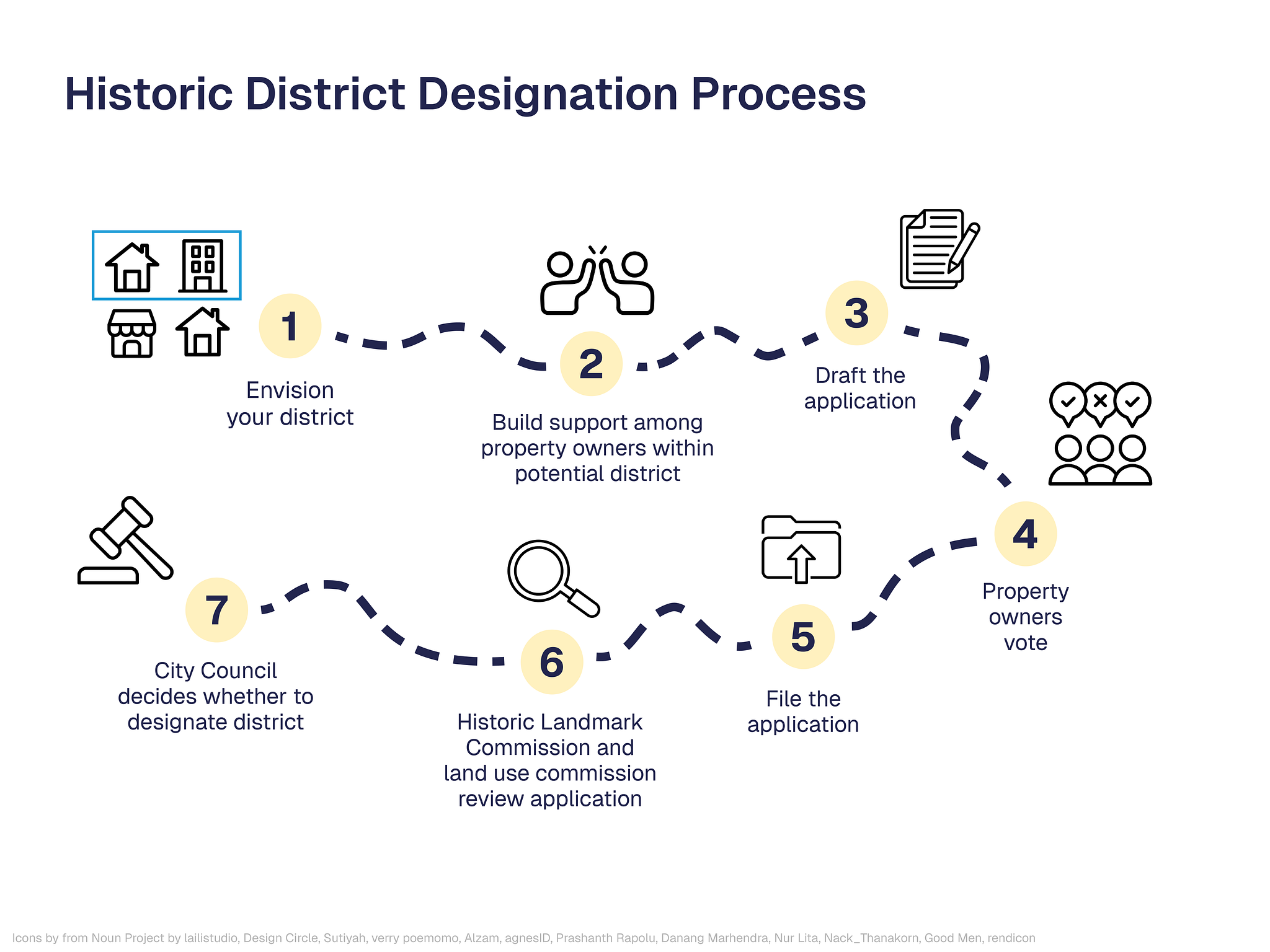
Completing the Historic District Application:
- The application process involves significant effort and time, including extensive outreach. The City helps to facilitate the process, but community members do most of the work on an application.
- While individuals have successfully spearheaded historic district applications, it is recommended that applications are completed by a team. This may be a subcommittee of an existing neighborhood organization or a less formal group.
- For more detail on the application process, refer to Local Historic Districts 101 and the Historic District Application Guide.
- If you aren’t sure whether your proposed district would meet the eligibility criteria or not, the Research Guide (guía en español) provides guidance on researching buildings and neighborhoods.
Review of Application: Once you submit the application, the review process begins. A historic district application is reviewed by the Historic Landmark Commission approximately four to six weeks after application submittal. The application is then reviewed by either the Planning Commission or the Zoning and Platting Commission, and finally by the City Council. At each of these public hearings, community members may provide testimony on the proposed district. For more information on this process, refer to the Historic District Application Guide.
Key Considerations
Responsibilities and Benefits: Changes to contributing properties, and new construction on any property, must go through historic review. A rehabilitation tax abatement supports good stewardship and reinvestment. For details, see I own a property in a historic district section above.
Property Values: Restrictions conferred by historic district designation mean that property values may not be immediately maximized. For example, demolishing an older contributing building and constructing the biggest possible new building may be most profitable in the short term, but it would not be allowed in a historic district. Analysis shows that property values in Austin’s historic districts continue to rise, but at a slightly lower rate than in surrounding areas. This means that yearly property taxes stay more predictable in the short term.
In the long term, studies across the U.S. show that properties in historic districts appreciate at a higher rate than similar properties, making historic districts a good investment.
Austin’s Local Historic Districts
Albert Buddington, a prosperous local settler, built the first home in this area in 1860. In 1912 Lewis Hancock platted Aldridge Place as “the suburb beautiful,” hewing to the nationally popular City Beautiful style and taking advantage of proximity to the University of Texas and the streetcar line.
Development was initially slow, but the end of World War I led to growth as prosperous professionals purchased homes along the neighborhood’s winding streets. During the Great Depression, construction continued apace, and many property owners converted garages into apartments by adding a story. By 1941, Aldridge Place was nearly fully developed. Ranch Style and Mid-century Modern houses filled the remaining lots in the late 1940s-1950s.
Notable places in the 46-acre historic district include Albert Buddington’s 1860 limestone plantation house and Hemphill Park, which features original landscape elements and rough-hewn elements constructed as part of the Depression-era Works Progress Administration’s New Deal.
Learn more about Aldridge Place.
James Raymond, the last treasurer of the Republic of Texas and the first treasurer of the State of Texas, originally owned this area. In 1869, the Texas Military Institute (TMI) constructed the iconic "castle" that is the district’s namesake. Two years later, Raymond platted the first subdivision in West Austin, “Raymond Heights,” with sizeable lots along W. 6th Street. Most of these lots soon were developed with large mansions, five of which remain.
The City's first streetcar line ran along what is now W. 6th Street beginning in 1891. It sparked the second major wave of development by providing an easier route to downtown businesses and services.
Notable places in the 39-acre historic district include Fire House #4 and a Moonlight Tower at the corner of West 12th and Blanco Streets.
Harthan Street was developed over time with a variety of architectural styles. The oldest house in the district is a ca. 1875 Italianate villa. Neo-Classical detailing appears on a late Victorian vernacular cottage and several modest transitional cottages from the early 1900s. Houses from the 1910s and 1920s reflect the change from transitional cottages towards bungalow forms. The most recent house built on the street is a Spanish Colonial Revival house, reflecting the popularity of period styles in the late 1920s and early 1930s.
The block-long district includes ten houses, of which nine of which contribute to its historic character.
Platted in 1891, Hyde Park was initially marketed as an affluent suburb featuring large homes for wealthy residents. A new streetcar line—built by the main neighborhood booster, Monroe Martin Shipe—provided reliable transportation to downtown. Churches, schools and stores such as the Avenue B Grocery and the Hyde Park Presbyterian Church were encouraged to locate in the neighborhood.
Sluggish early land sales led to a marketing shift, and Hyde Park became a neighborhood for the middle and working classes. As a result, the architectural character shifted to smaller houses. While Hyde Park grew steadily throughout the first decades of the 1900s, its biggest building boom occurred between 1924 and 1935 and resulted in a wealth of bungalows.
The 186-acre district includes 640 properties, of which 480 are contributing. Designated historic landmarks within the district include many homes, the Hyde Park Fire Station, and a moonlight tower. Architectural styles reflect the transition from the Victorian Age to the 20th century.
Mary Street was platted in 1928 as part of the Blue Bonnet Hills Subdivision, and the first home in the district was constructed the following year. When the neighborhood was developed, its distance from downtown was a deterrent to wealthier families who preferred to live closer to amenities and businesses. Thus, the 500 block of E. Mary Street was part of a working-class neighborhood comprised of a mix of homeowners and renters, including many World War I veterans. Early residents commuted to workplaces downtown, where many were employed in federal and state government and blue-collar jobs.
The historic district is located near the Blunn Creek Greenbelt—a result of the City Beautiful Movement that shaped Austin and other cities around the country. City Beautiful planners prized order and harmony in design and prioritized parks and green space in rapidly growing cities.
The 3-acre historic district contains 19 residential buildings, of which 16 are contributing. The style, scale, and age of the housing stock on Mary Street is similar to that of the surrounding area: primarily one-story, modest-scale homes in the Craftsman, Tudor Revival, and Minimal Traditional styles.
The varied history of the Robertson/Stuart & Mair Historic District reflects that of Austin and the State of Texas. The district’s earliest building is the French Legation, which was built in 1840 for the French representative to the Republic of Texas. At that time, the building was located in a rural area called the Outlots. After the Civil War, the Outlots were subdivided and sold to newly free African Americans and European immigrants. The African American landowners settled on the west edge of the district in a community first called Pleasant Hill and later Robertson Hill; European immigrants settled in the central and east portions of the district.
Throughout the 20th century, the district’s population grew to include more African Americans, Mexican Americans, and Lebanese Americans. Significant turning points included the 1928 city plan that segregated Austin by restricting public services east of East Avenue (now I-35) and, after World War II, the exodus of predominantly white households to the suburbs. Though the district’s population decreased in the postwar period, Mexican American households continued to move there, and African American community institutions in the district and nearby remained strong. After 1956, East Avenue was widened into I-35 and many properties in the Robertson Hill community were demolished.
The Robertson/Stuart & Mair Historic District contains 123 principal buildings, of which 85 are contributing. Most contributing buildings were constructed as residences; the district also includes a church and a commercial building. Principal architectural styles include Victorian and Folk Victorian, National Folk, Craftsman, and Minimal Traditional.
The Rogers-Washington-Holy Cross Historic District is a postwar neighborhood that demonstrates the determination and success of the African American community in Austin. The neighborhood was developed by Black professionals for Black professionals. This was a major milestone at a time when many white Austinites with similar socioeconomic and community standing were buying suburban homes and moving out of the city. Racially restrictive covenants, redlining, prejudiced lenders, and other social and governmental barriers prevented African Americans from making the same move.
Early residents of the district included Huston-Tillotson Chancellor John Q. Taylor King; Carnegie H. Mims, Jr., the first Ombudsman at the University of Texas; T. C. Calhoun, longtime principal of Kealing Junior High School; and numerous other educational leaders, including Willie Mae Kirk, Carnegie Harvard Mims, Sr., and Ira Poole. The Kirk family lived on Maple Avenue; Ms. Kirk’s husband Lee Sr. was the first African American postal worker and certified pilot in Austin, and her son Ron served as Dallas’s first African American Mayor and a cabinet member in President Obama’s administration. Jimmy Snell was a City Council member who served as the first Black Mayor Pro Tem. Norman Scales was a member of the famed Tuskegee Airmen. Prominent business owners, some of the earliest graduates from UT following desegregation, and even more leaders also called the neighborhood home.
John Chase, the first African American graduate of UT’s School of Architecture and the first licensed African American architect in Texas, designed several houses in the neighborhood, attesting to residents’ prominent standing and creating a rich architectural legacy. Nash Phillips, a well-known and prolific Austin builder, constructed houses along Maple, Givens, and Werner avenues.
The Rogers-Washington-Holy Cross Historic District contains 55 properties, of which 47 are contributing. The district is entirely residential. The prevailing architectural style is Ranch; other styles include Minimal Traditional, Split Level, and Contemporary/Mid-Century Modern.
The Smoot/Terrace Park Historic District was first developed as country estates on more affordable land outside of what was then a much smaller city. In 1877, while much of Austin’s upper class was building mansions close to downtown, five country estates were built in Smoot/Terrace Park on larger parcels of land. The homesteads from all five estates remain standing.
The late nineteenth century saw the development of residential suburbs accessible to the middle class. The West Line streetcar was constructed along Pecan Street (now W. 6th Street) in 1891, but suburban development along the line did not begin until 1911. Through the 1910s and into the 1920s, middle-class families purchased lots and constructed single-family houses (mostly Craftsman bungalows) in the area. Steady development continued until the mid-1940s.
The Smoot/Terrace Park Historic District contains 81 principal buildings, of which 52 are contributing. All contributing buildings were constructed as residences, with nearly all remaining in that use. Architectural styles include Italianate, Craftsman, and Colonial Revival.