
Street Maintenance Program
Austin has 8,000 lane miles of streets and 2,500 centerline miles. Austin Transportation and Public Works uses various strategies to improve and maintain City of Austin-owned roadway surfaces. Scheduled preventive maintenance helps prolong the lifespan of these surfaces by protecting them from aging, cracking, deterioration, and water infiltration. Prolonging the life of our city streets saves time and taxpayer money by intervening before full reconstruction is needed.
What streets will be paved next?
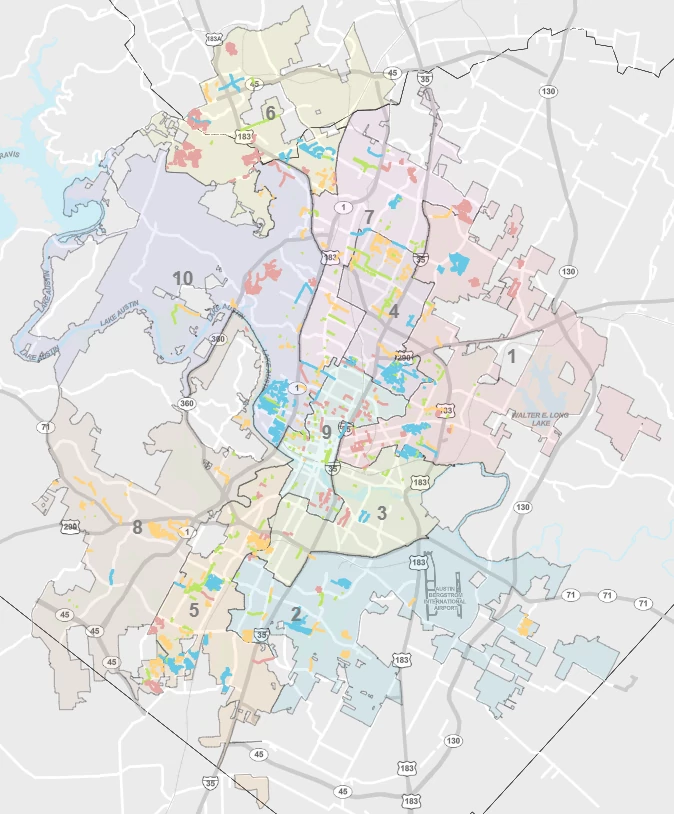
Use the interactive Street Maintenance map to see what streets are scheduled for maintenance this year. The map reflects our most current research and is updated annually. Our goal is to maintain at least 80 percent of Austin’s streets in fair or better condition.
Five Types of Pavement Treatment
Our five main treatment types include sealcoat, overlay, slurry seal, crack seal and fog seal. The City of Austin uses a Pavement Information System (PMIS) to track pavement inventory and performance, which helps to assign appropriate treatment types at various locations.
- Sealcoat
One of the more notable treatment types we use on streets is sealcoat. This is a cost-effective maintenance solution that is applied from April to October each year.
To apply, crews spray an oil mixture on the road then spread and roll the gravel mixture into place. Finally, they sweep up excess gravel, resulting in a smoother surface that eliminates the hairline cracks that lead to potholes.
Residents who live along streets identified for sealcoat treatment will receive a notice before scheduled work. These residents will be asked to move vehicles away from streets scheduled for maintenance for two days.
Streets can be used immediately after treatment, which is typically done in 30 minutes. However, hard braking or turning over newly-sealcoated streets should be avoided, since this can cause an increased amount of small gravel particles to break loose from the road before the treatment cures. Crews will return for additional sweeping of loose gravel if needed. Residents can expect loose gravel to settle in roughly 4-6 weeks.
Sealcoat is not applied in cul-de-sacs due to sharp turning by vehicles in these areas. Instead, a slurry seal treatment may be applied in cul-de-sacs.
- Mill and Overlay
Mill and overlay involves grinding up the existing asphalt and base material, removing it, and applying new pavement. The result will be a much smoother driving surface. Overlay consists of a single layer of hot mix asphaltic concrete used to level, waterproof, and restore the original street shape and ride.
- Slurry Seal
A slurry seal is a mixture of asphalt, water, fine aggregate, and mineral filler withy a creamy fluid-like appearance. Slurry seals fill existing pavement surface defects as a preparatory treatment for other maintenance treatments. This treatment is also used in cul-de-sacs.
- Crack Seal
Crack seal consists of sealing the cracks in the pavement with a sealant or asphalt-sealing product to prevent moisture from entering into the base and subgrade material.
- Fog seal
Fog seal is a light application of diluted asphalt mixture. The seal is used to renew aged asphalt surfaces and to seal small cracks and surface voids.
Report an Issue
To report a pothole or other street maintenance issue, call 3-1-1 (512-974-2000) or visit the Austin 3-1-1 website.
Sealcoat Frequently Asked Questions
A sealcoat is a preventive maintenance surface treatment designed to preserve and extend the life of a street. Like brushing your teeth or changing the oil in your car, preventive maintenance prolongs the life of your street conditions by preventing premature deterioration.
Residents may call the Street Resurfacing Hotline at 512-974-9788 for the locations that will be sealcoated the next day. The hotline is updated every weekday at 2 p.m.
Sealcoat is extremely effective and inexpensive, improving efficiency with our tax dollars. The City of Austin has been using the sealcoat process for several decades to keep streets in good condition and prolong their lifetime.
The street aging process is slow at first, but after nine to 10 years, it accelerates. Cracks widen, allowing more water to enter and creating potholes and patches. Sealcoat is applied to streets to prevent oxidation and slow cracking. This treatment can substantially extend the life of a street by up to 15 years.
Cars along streets scheduled for maintenance need to be moved during crew work time. This is from 7 a.m. to 7 p.m. seven days a week. If rain is forecast, the street will be rescheduled for the next clear workday. Residents may call the Street Resurfacing Hotline at 512-974-9788 for the locations that will be sealcoated the next day.
On most streets, the first pass of work is done very quickly, taking about 30 minutes per block and lane. Some driveways may be closed during this time. The first sweeping will take place for 24 to 36 hours after treatment.
It takes about a month after sealcoat maintenance for the new surface to completely cure and lock firmly into place. During this time, the road is open to regular traffic.
Some gravel particles will break loose under hard braking or fast acceleration. Because we do not move parked cars during the sweeping phase, some loose gravel may remain underneath. Additionally, sweepers may occasionally miss spots, particularly at intersections or corners. However, all of this typically amounts to less than a gallon of gravel per block.
Please call 512-974-8777 if you need crews to sweep up any excess gravel left on your street.
Yes. Sealcoat is made of a water-based asphaltic binder that contains no coal tar. Coal tar has been implicated as a contaminant in stormwater runoff. The asphaltic binder Austin uses is a completely different material. The sealcoat used to protect the aging street surface does not leach, crumble, or break down.
If the asphaltic binder is tracked onto shoes, carpets, or cars, WD-40 will soften the asphalt and allow it to be wiped off (spot-test carpets for color stability). If the material becomes stuck to people or pets, baby oil will help dilute it.
If the material is tracked onto a concrete driveway or sidewalk, do not dilute it, as it will soak into the concrete. If a large area is involved, sand blasting can remove the asphalt, but excessive blasting could damage the concrete finish. For smaller areas, it may be better to let the material wear off with normal traffic.
The surface will smooth out over the first four to six weeks as the material cures and the gravel particles interlock and embed into a tighter surface. While this process is slow, it is happening. The street will look completely different in six to eight weeks with a darker, tighter, smoother surface. It will never be as slick as the old surface, but it will provide better wet-weather traction and preserve the street's remaining life.
Mill and Overlay Frequently Asked Questions
Mill and Overlay involves grinding up the existing asphalt, removing it, and applying a new hot-mix asphalt surface layer. The result will be a much smoother driving surface.
The major benefits of Mill and Overlay are to reduce surface roughness and address minor deformations, cracking, and irregularities in the pavement surface, resulting in a much smoother ride quality and longer overall pavement life. This type of resurfacing treatment prevents the City from having to perform a full street reconstruction, which can be costly and time-consuming.
The mill and overlay process is performed in two phases. Phase 1 involves the grinding or milling and removal of the asphalt layer. The second phase involves placing a new layer of asphalt concrete surface. In normal conditions, it is a two-day operation. As always, schedules are projected as accurately as possible but are subject to change due to the nature of maintenance construction and weather.
The street will remain open to traffic; however, access to driveways will not be available when the new pavement is being placed in front of the driveway. We encourage drivers to use extra caution while in the work zone. Once the material is placed, rolled and compacted, vehicles may drive slowly on the new pavement.
Following the street resurfacing work, crews will install pavement markings and striping within two weeks.
An orange doorhanger is placed on each residence two weeks prior to work, advising that crews will be on your street to perform routine street maintenance. The notice is a postcard letter that will be delivered to affected homes/properties about a week in advance to remind residents that crews will be on their street and to provide details on the schedule and process.
A series of "No Parking" signs will be posted along the street at least two days prior to the work, reminding residents not to park within the work zone from 7 a.m. to 7 p.m. Check the Street Maintenance Map to see if your street is scheduled for maintenance this year.
The mill and overlay treatment is needed to preserve the underlying pavement structure and to provide a smoother ride quality. Streets are selected based on pavement conditions.
It is the property owner's responsibility to maintain and repair the driveway. Mill and overlay is strictly for street maintenance only.
The entire street surface is being replaced, and full width is needed for the equipment and passing vehicles. Affected residents are notified in advance to remove parked vehicles. Any vehicles left on the street on the day of the scheduled work will be towed to a nearby street so the scheduled street maintenance can be completed.
The crews work between 7 a.m. and 7 p.m. seven days a week. Depending on the type of street, weekend or overnight work may be necessary.
Yes, during milling and paving operations, City crews will assist you. For your safety and the City's crews, we request that you do not drive while crews are working near your driveway. However, in case of an urgent need to get in or out of your driveway, crews will be available to assist you.
Most milling and paving work is scheduled outside routine trash pick-up days/schedules, with little or no conflict with the pickup schedule of Austin Resource Recovery.
On some City of Austin streets, preventive maintenance work can only be scheduled on weekends. Weekend work ensures minimal traffic impact to residents and businesses. The City will notify the public before weekend work is scheduled on their street.
As soon as the job is complete, you can drive on the freshly resurfaced street. Do not drive on the fresh pavement until it has been rolled and compacted; that process takes approximately 45 minutes.
Preventive maintenance is scheduled as appropriate based on street condition, planned utility work, and the time since last maintenance.
Prior to scheduling paving on any street, the City coordinates scheduled work with both city and private utilities. As public rights-of-way are shared by many utilities, there is always a chance of some unforeseen events, such as leaks or ruptures in water, wastewater, gas lines, or new service requests, that may affect the street.