

City of Austin Adopts Tree Equity Score to Guide the Future of Urban Forestry
In Austin, trees are more than shade. They are essential infrastructure—cooling neighborhoods, improving air quality, hosting wildlife, and supporting public health. Just as importantly, access to tree canopy is an equity issue. Not all communities experience the benefits of trees equally across our community, and that reality shapes how the City approaches urban forestry planning.
To strengthen this work, the City of Austin is retiring the Community Tree Priority Map and adopting the nationally recognized Tree Equity Score as its primary decision-support tool for tree equity planning. The transition is being led by Austin Climate Action & Resilience’s Urban Forest Program and reflects both a technical evolution and a continued commitment to equity-centered action.
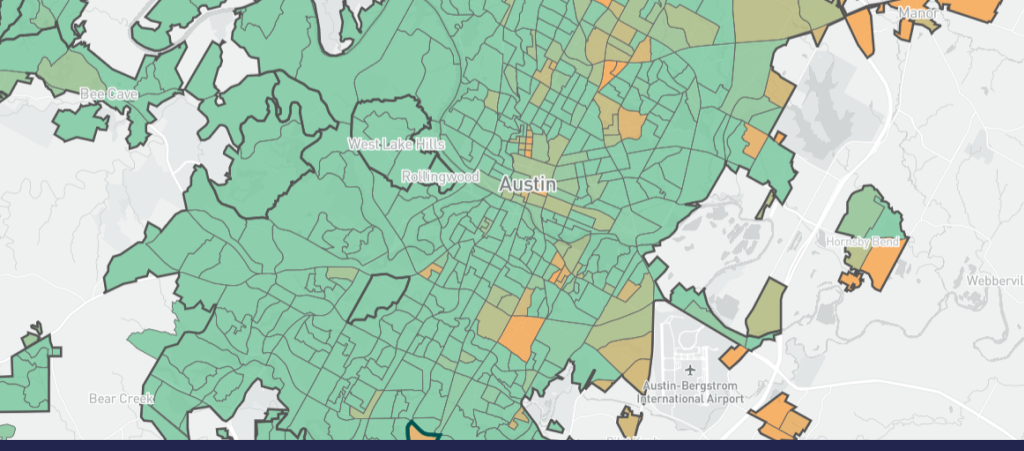
A map showing Tree Equity Scores across Austin. Areas in yellow represent higher need.
Why we’re making this shift
While the tool is changing, the mission is not. Austin remains firmly committed to expanding and sustaining the urban forest, using spatial analysis and data-driven approaches to guide tree planting, investment, and long-term planning. Equity remains at the core of this work.
Tree Equity Score provides a robust, nationally standardized framework for identifying communities with the greatest need for tree investment. Developed and maintained at the national level, the tool integrates data on tree canopy cover, income, employment, health, and heat burden into a single score. It is designed specifically to help cities ensure that the benefits of trees reach neighborhoods facing higher environmental and socioeconomic challenges.
By adopting Tree Equity Score, Austin aligns with national best practices while also increasing transparency and accessibility. The tool’s methodology, data glossary, and change log are publicly available, and updates are rolled out regularly, including a new Spanish-language version that expands access for more residents. This shift also allows City staff to spend less time maintaining datasets and recalibrating indicators, and more time advancing implementation, partnerships, and canopy expansion on the ground.
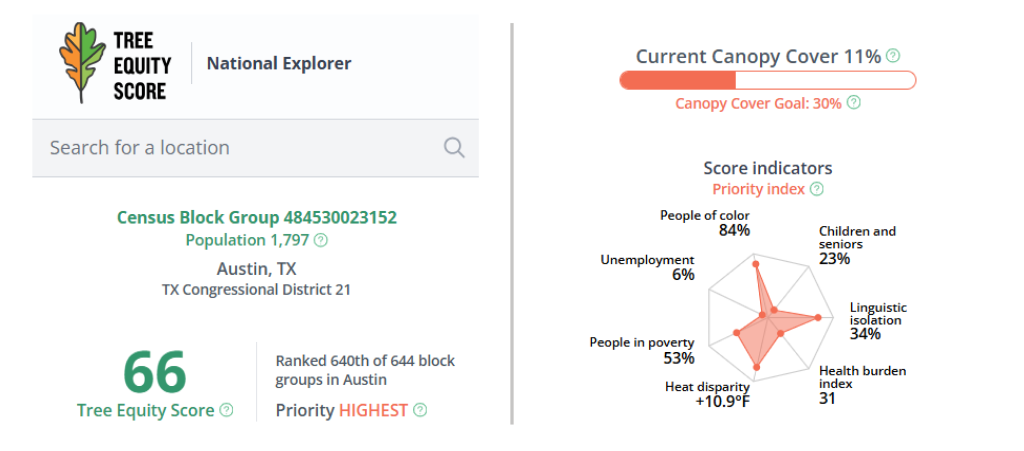
This is an example of Tree Equity Score data. In the East Riverside-Oltorf neighborhood, a Tree Equity Score of 66 underscores the need for increased canopy cover, which currently stands at 11%.
Addressing this gap is vital to supporting this diverse community, particularly in mitigating heat disparity, which is over 10 degrees higher than the citywide average, and ensuring environmental benefits are accessible to all residents regardless of language or racial background.
How we will use the Tree Equity Score
Tree Equity Score will serve as a baseline tool to inform Urban Forest Program planning activities, including tree distribution strategies and the review of Urban Forest Grant applications. As with any tool, it will not operate in isolation. Professional expertise, local knowledge, and community insight remain essential to decision-making. Data helps guide the conversation, but it does not replace lived experience or practitioner judgment.
The transition directly supports the Austin Climate Equity Plan’s goal to achieve at least 50% citywide tree canopy cover by 2050, with a focus on increasing canopy cover equitably. Designing equity into projects from the outset improves long-term outcomes and ensures that public investments are responsive to community needs. Tree Equity Score strengthens this approach by providing a consistent, transparent foundation for prioritizing investment.
The change will impact a wide range of partners and practitioners, including Urban Forest Grant applicants, nonprofit and municipal collaborators, arborists, Youth Forest Council interns, and Urban Forestry staff. For those who previously relied on the Community Tree Priority Map, the Tree Equity Score will now serve as the primary reference point for understanding tree equity conditions across Austin.
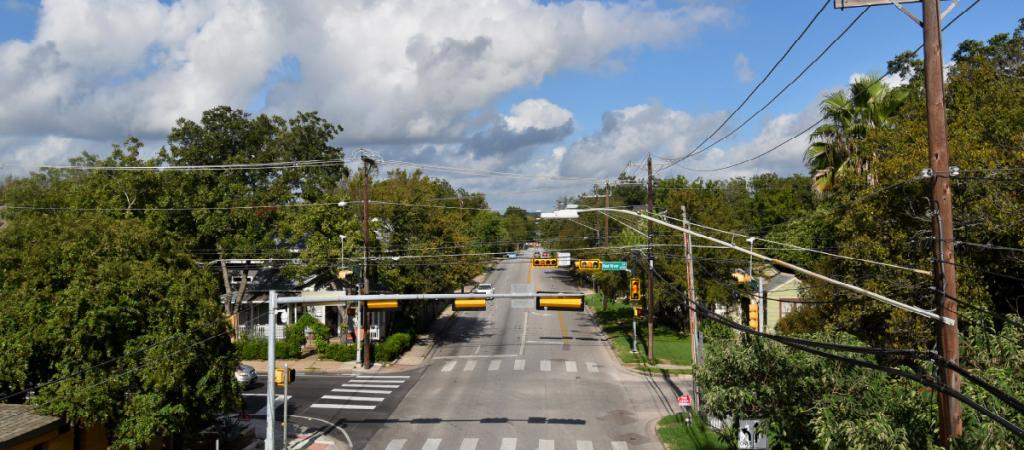
Tree canopy cover at 45th and Red River Street in Austin, Texas.
Looking ahead
As the City moves into this next chapter, detailed technical FAQs will be released to clarify how the Tree Equity Score will be applied locally and outline the roadmap for formally sunsetting the Community Tree Priority Map.
We invite community members and partners to explore Tree Equity Scores across Austin and engage with the data firsthand.
Visit treeequityscore.org to begin exploring.
Questions? Email us at thinktrees@austintexas.gov.