
March 8, 2016
February 11, 2026
Ball Moss - Just Hanging Out

What is ball moss?
Ball moss is a small epiphyte commonly found clinging to limbs of live oaks and other trees in southwest Texas. Ball moss is not a moss, but a true plant with flowers and seeds. It is a member of the bromeliad family, which also contains Spanish moss and pineapple. Epiphytes are plants that attach themselves to limbs, tree trunks, power lines, fences, and many other structures with pseudo-roots. Unlike true roots, they do not absorb water and minerals; they merely attach the plant to an aerial structure. Since epiphytes do not take nutrients and water from these aerial structures, they are not parasites; therefore, ball moss is not a parasite.
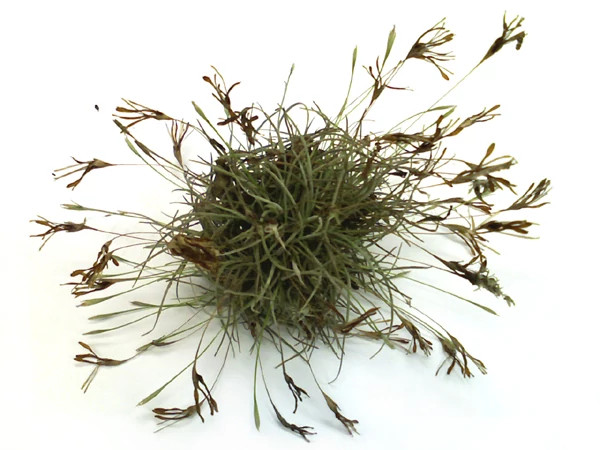
Tillandsia recurvata; Family: Bromeliaceae
(bro-mee-lee-AY-see-ee)
Genus: Tillandsia (til-LAND-see-uh)
Species: recurvata (rek-er-VAY-tuh)
Is it killing my tree?
If ball moss isn't a parasite, why do the branches covered with it seem to be dying? There is a lot of controversy about this. If you take careful notice, you will observe that the majority of these dead limbs are in the interior of the tree's canopy. Ball moss prefers an environment with low sunlight intensity and higher humidity. The interior canopy of trees (especially live oaks) provides an ideal environment for ball moss. These interior limbs die from a lack of sunlight, rather than from the ball moss plants colonizing these branches. If the tree is heavily covered with ball moss to the extent that the plants are covering the exterior of the canopy, then control is recommended. If it is a light to moderate infestation, control is not necessary for the health of the tree.
How do I control ball moss?
First, note whether other trees in the area are also colonized by ball moss. A tree that has been cleared of the plant can be quickly re-colonized if neighboring trees are infested. Because of this, thoroughly controlling ball moss may require neighborly or community cooperative effort.
Ball moss can be controlled using three methods: picking, pruning, or spraying. Each method alone may not provide adequate control. Using a combination of all three methods may result in the most thorough treatment.
Picking involves physically pulling each plant off the tree. This method can be very effective, but is extremely tedious and labor-intensive. It can also be quite dangerous without proper equipment. Please use caution and practice proper safety techniques if employing this method.
Pruning involves removing dead, interior limbs from the tree and/or lightly thinning the canopy. The majority of the ball moss is growing on the dead, interior limbs; therefore, by removing these limbs, you physically remove the majority of the ball moss. As mentioned above, ball moss prefers areas with low sunlight intensity. Light thinning of the canopy (only if necessary) allows more sunlight to reach the interior of the tree, discouraging future infestation. When pruning, always follow proper pruning techniques to avoid damaging the tree.
Spraying can involve applying either a simple baking soda mix or a specific chemical as a foliar spray. Kocide 101 has been shown to provide adequate control. Do not exceed the recommended rates for this chemical, since higher concentrations can actually damage the tree. The ball moss will shrivel up and die in 5 to 7 days, but will remain in the tree until the wind or rain knocks it out. For this reason, it is recommended to prune out the deadwood first. In doing so, you will likely remove most of the ball moss from the tree and practice good tree maintenance at the same time. Neither picking, pruning, nor spraying will remove all of the ball moss from the tree, but these treatments can certainly help to control it.
Learn more about trees and tree resources at the Tree Information Center.