
April 30, 2026
April 30, 2026
Net-Zero Hero: Billy Fairley

I’m helping to make Austin Net-Zero by thrifting denim that might have eventually ended up in landfills and reimagining it into completely different garments.
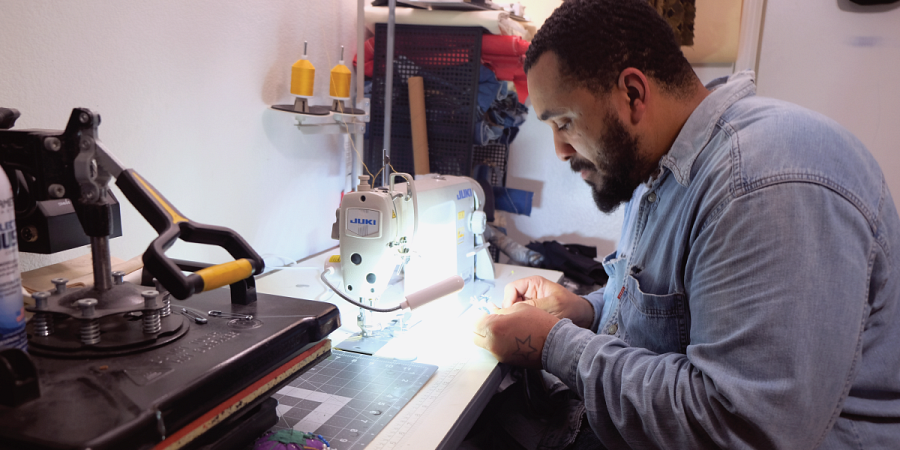
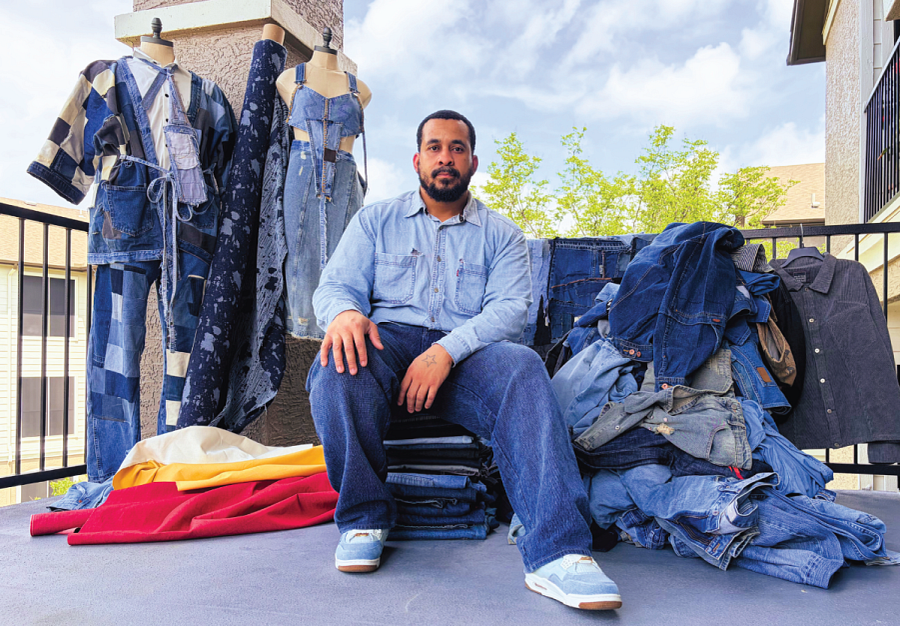
Meet our newest Net-Zero Hero: artist and fashion designer Billy Fairley. Working out of his home studio, Billy carefully deconstructs thrifted denim—separating seams, salvaging pockets, waistbands, and panels—then rebuilds them into entirely new pieces. Nothing goes to waste: even the smallest scraps are saved and stitched together into new textiles for future designs.
For Billy, the practice honors his own love of denim, while also speaking to his family lineage and identity. Billy wants all of us to have quality clothes that tell a story—both about what they once were and who we each are.
We sat down with Billy to learn more about what drew him to upcycled fashion, how his family history shaped his creative process, and what he thinks the future of sustainable design looks like.
What inspired you to take action?
My interest in fashion really started long before I realized it. Growing up, my mom and sisters influenced how I dressed. My mom especially paid attention to how I looked. She styled me in a lot of streetwear and color-blocked outfits. I still remember wearing my Taxi 12s for my first-grade school pictures with a matching Nike windbreaker set and a small gold chain that said “Billy.” At the time, I didn’t think of it as fashion, but looking back, those moments definitely shaped how I see clothing.
About three years ago, I started studying fashion design. At the time, I wasn’t planning to work with upcycled materials. Like most students, I was using brand-new fabrics while learning construction and design. But over time, I started reflecting on the clothes I grew up around and the styles that stuck with me. One of those staples was denim, especially pieces like Marithé + François Girbaud jeans.
Around that same time, I was working as a Merchandising Manager at American Eagle. Being around denim every day made me start paying closer attention to it. I began noticing that a lot of modern denim wasn’t built the way it used to be. Many pairs were made with less cotton and more synthetic fibers, and the focus seemed to be more about trends than durability. That made me start asking myself what happened to denim. Denim used to represent durability and culture. Seeing the difference between older denim and what is produced today made me start thinking differently about the material.
Eventually, I started going into Goodwill looking for older denim. Instead of finding rare designer pieces, I kept seeing racks of Wrangler work jeans for six or eight dollars. That caught my attention because those jeans had clearly been worn for years—sometimes decades—by someone working a blue-collar job, and they were still holding up. That told me the textile itself had real integrity.
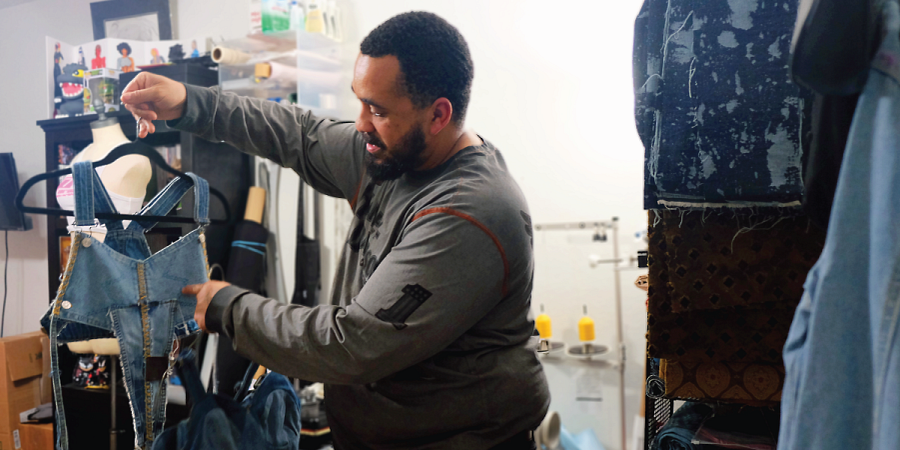
At that point, it clicked for me: those thrifted jeans weren’t just clothes someone had donated—they were durable materials with history behind them. They became the perfect starting point for developing my designs.
Working with thrifted denim also helped me move away from the idea that everything in fashion has to be perfect. Upcycling is naturally imperfect, and that’s part of its strength. Each garment carries traces of its previous life, and those imperfections become part of the design.
How did you do it?
The process always starts with thrifting. I spend a lot of time going through racks at places like Goodwill, looking for denim that has good weight and durability. Most of the time, it’s older workwear—Wrangler, Levi’s, or other jeans that have clearly already lived a long life. Those garments become the foundation for everything I make.
When I bring them back to the studio, I start by carefully taking them apart. I separate the pieces at the seams so I can keep as much usable fabric as possible. Instead of treating it as a finished garment, I break each piece down into its components—pockets, waistbands, leg panels, zippers, and smaller details that can all be used again in different ways.
From there, I start rebuilding. The larger panels might become the base of a new garment, while smaller elements like pockets, fly fronts, and waistbands become structural details or finishing pieces. I don’t throw scraps away, so anything left over gets saved and stored for later projects.
Over time, those scraps begin to accumulate, and I start combining them into new textiles or patchworked surfaces that can be used in future garments. The process becomes cyclical. One garment leads into the next, and materials continue moving forward instead of ending up as waste.
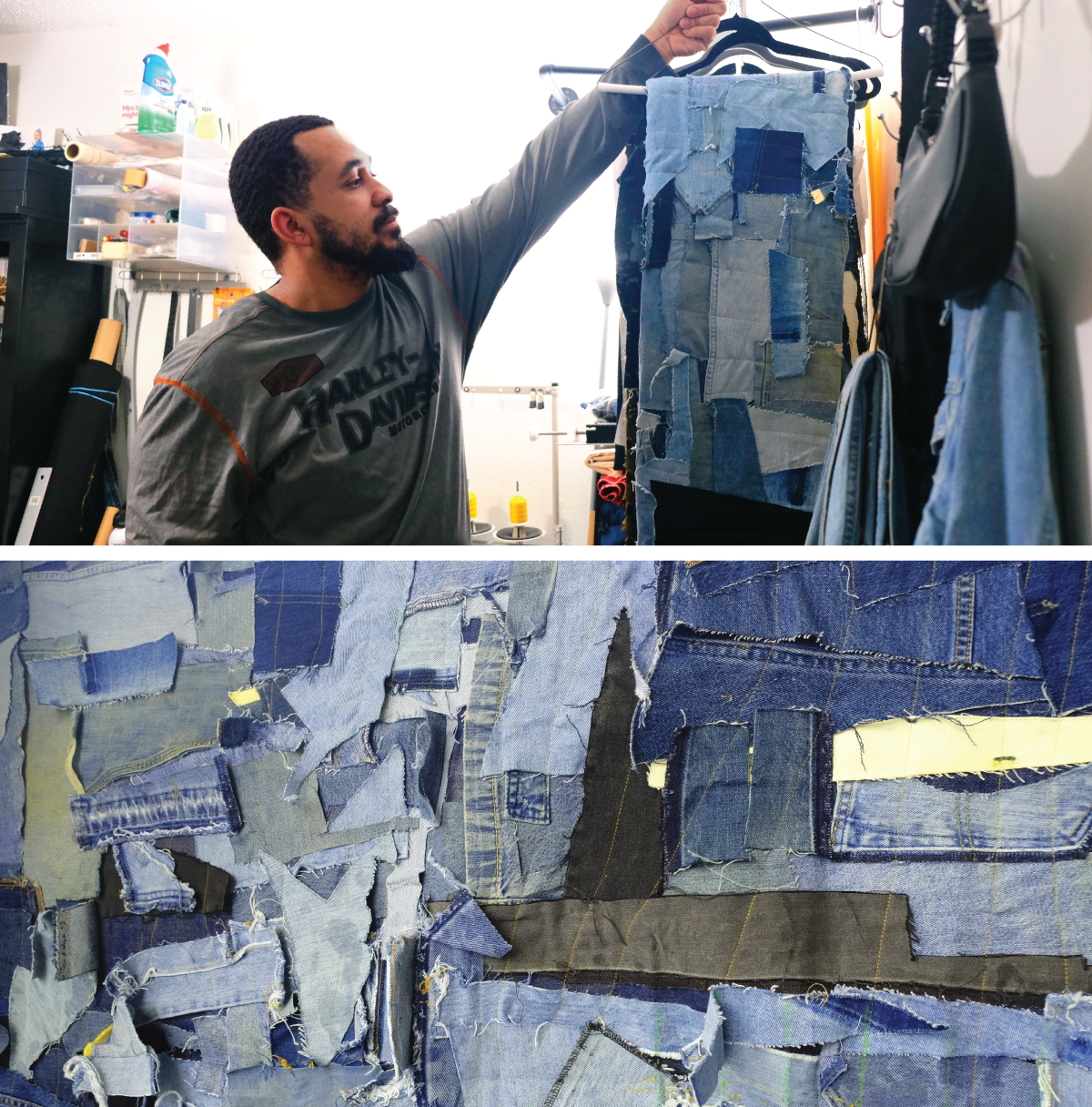
Working this way means every piece develops differently. The garments aren’t created from perfect yardage—they’re shaped by the materials that already exist.
Even the pocket bags serve a purpose. I use them to hold the smaller scraps left over so they can eventually become part of something larger, like developing a new textile made entirely from scraps. It becomes a continuous cycle of reduce, recycle, and reuse.
What’s been most rewarding about getting involved in this way?
For me, the most rewarding part is impressing my mother.
She has always been one of the biggest influences on how I see clothing. She worked at Covington Needleworks doing cut-and-sew for different manufacturers like K-Mart and Levi’s, so she understands garments from the inside out. Whenever I finish something, I show it to her. Hearing her say that something looks neat or getting a pointer from her—like how to turn a collar point better—is honestly the most meaningful kind of recognition I could receive.
Garment-making also runs through my family in other ways. My aunts have always been involved in design, and my great aunt designed cheerleading uniforms and did custom tailoring. In many ways, the work I’m doing now feels like a continuation of that tradition.
I also think about the younger people in my family—my nieces and nephews—and showing them that you can make something with your hands and find fulfillment in it.
Coming from Mississippi, there are also deeper cultural layers connected to cotton and textiles. I recognize that history, but my own connection to denim comes from a more personal place. I grew up in a time when putting on a good pair of jeans could make you feel good inside. That feeling is something I carry into the work.
What’s been the toughest part?
One of the toughest parts is working within the limitations of the materials themselves. When you design with thrifted denim, you’re not starting with clean yardage from a fabric store. Every pair of jeans has different washes, wear patterns, seam placements, and fabric weights. That can make it challenging to bring different pieces together into a single garment that still feels cohesive.
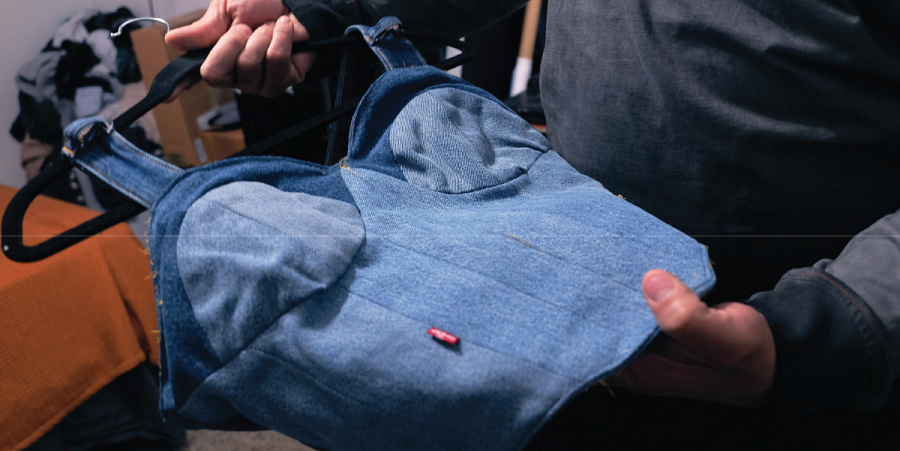
The process of deconstructing garments also takes a lot of time. You have to carefully take things apart to preserve as much usable fabric as possible. Sometimes hours go into breaking down a few pairs of jeans before you can even begin constructing something new.
Another challenge is working with irregular shapes. Denim panels from existing garments aren’t cut like traditional pattern pieces, so you often have to design around what already exists rather than starting with a blank slate. It requires a lot of problem-solving.
Earlier this year, you were featured in Austin Creative Reuse’s Reuse on the Runway fashion show and exhibit at the Dougherty Arts Center. Can you share some of the highlights of this experience?
One of the highlights for me was seeing the garments exist outside of my workspace. Most of the time, the work happens quietly—thrifting, deconstructing denim, and rebuilding it into something new. Seeing those pieces move on the runway and be displayed in an exhibition at the Dougherty Arts Center gave the work a different kind of life.
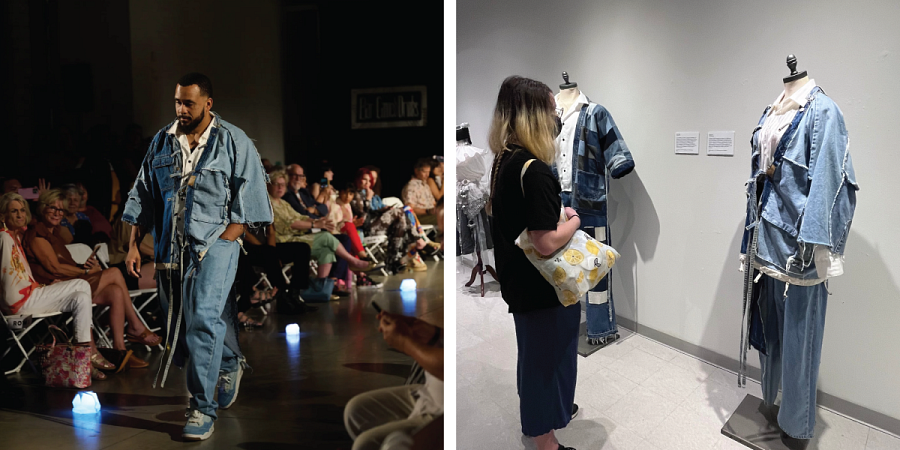
It was also meaningful to be part of a show centered around reuse. Everyone involved was approaching materials thoughtfully. This approach created an environment where experimentation and imperfection were welcomed rather than avoided.
Because the garments are made from thrifted denim, traces of the original clothing items remain visible. Seeing that history carried into a runway and exhibition setting was a powerful moment in the process.
What does the future of sustainable fashion look like to you?
Honestly, I think upcycling will likely remain a niche part of the fashion industry. There have been designers who built their work around ideas of reduce, reuse, and reconstruction—someone like Martin Margiela is a good example. Early in his career, he used repurposed garments and found materials as the foundation of his designs. But even in those cases, the larger fashion industry eventually shifts back toward producing new garments.
A lot of fashion still revolves around the idea of clean, pristine clothing that looks untouched. Those kinds of garments don’t always reflect the lived experiences of the people who wear them. Upcycled garments carry history and imperfection, and not everyone in the market is comfortable with that.
Because of that, reconstruction and upcycling will probably stay within smaller communities of designers and makers who value that approach. Regardless of where the industry goes, I plan to continue developing garments through this process.
What advice do you have for others?
My advice to others, whether they’re designers or just consumers, is to demand quality in their lives. Don’t wear brands simply because they’re popular or trending. Pay attention to how garments are made, what materials are used, and whether something is actually built to last.
I see a lot of the same things when I’m out and about, and I’d like to see more individualism in how people dress. Clothing should reflect the person wearing it, not just whatever happens to be trending at the moment.
Is there a book, documentary, or other piece of media you would recommend for folks wanting to learn more about these topics?
One book that helped me think more deeply about my work is You’re Gonna Need a Bigger Story by Houston Howard. It encouraged me to think about the story behind what I’m creating and how that story connects to people. That perspective helped me develop my brand further than I had before.
Another book I’ve been reading is Contagious: Why Things Catch On by Jonah Berger, which explores why certain ideas, products, and trends spread and become part of everyday culture. For someone working in fashion and design, it’s interesting to think about how clothing and styles move through society and why some things stick while others fade.
Dive deeper
Meet Billy and view his designs on Saturday, May 2, 2026, from 1-4 p.m. at VITAE, Austin Community College’s Fashion Showcase. Should you find yourself in New York this fall, Billy has also been invited to participate in the New York Fashion Week Festival this September.
Shopping less and instead opting to repurpose or mend what we already own is one way to lower our carbon footprint. Visit the Austin Climate Equity Plan to discover more ways you can take action toward our community’s net-zero future!
Know a sustainability superstar?
Nominate them as a Net-Zero Hero by emailing Climate@AustinTexas.gov.