
May 25, 2026
May 25, 2026
Net-Zero Heroes: Ruhan Gupta and Varun Sanghavi

We’re helping make Austin net-zero by building machine learning tools that predict the spread of oak wilt, helping arborists and communities protect trees across Austin and beyond.
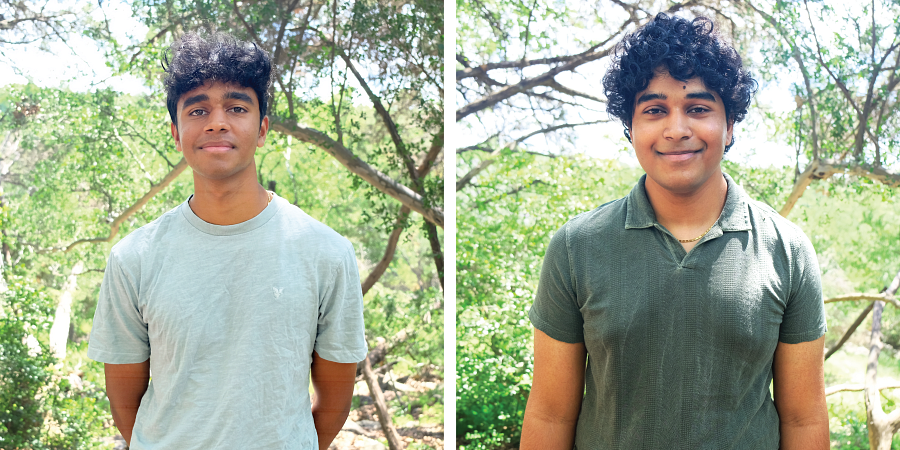
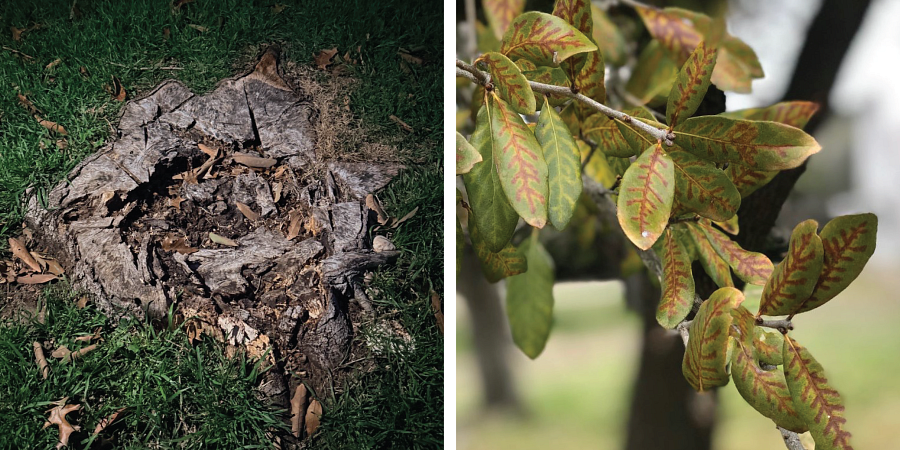
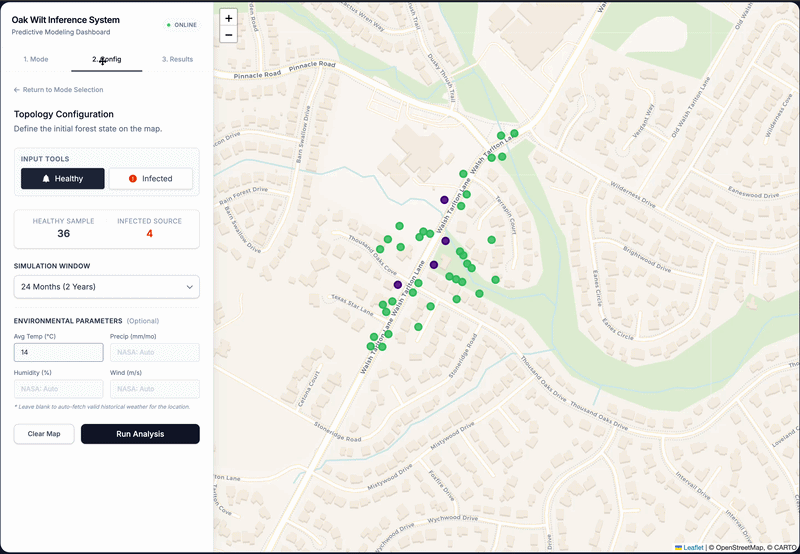
We are thrilled to introduce our latest Net-Zero Heroes: Ruhan Gupta and Varun Sanghavi, two high school juniors from Westwood High School who are using machine learning to fight one of Austin's most devastating urban forest threats: oak wilt. Oak wilt is an infectious tree disease that can infect even the healthiest oak trees. It’s spread through interconnected root systems below ground and by beetles moving from tree to tree above. Varun and Ruhan have built a platform called WiltCast, that uses predictive tools to map the spread of oak wilt, empowering arborists and residents to protect Austin's beloved tree canopy before it's too late.
Their story begins close to home. After oak wilt claimed a tree in Ruhan's own front yard, the two channeled their interest in modeling and data science into something that could make a real difference. The result is a tool trained on four decades of oak wilt case data and real-time environmental factors—wind, humidity, rainfall, and temperature—that gives arborists a new and powerful early-warning system. What started as a personal loss has grown into a resource with the potential to change how communities across Texas respond to this disease.
We met with Ruhan and Varun to learn more about what drove them to take action, how they built WiltCast from the ground up, and how they hope communities will use the tool for good.
What inspired you to take action?
Ruhan: There is a silent killer in our neighborhoods. For half the year, it lies dormant. Then the conditions align, and it tears through communities, killing trees that have stood for a century, leaving stumps where shade once was. Three years ago, it reached our front yard. We had a beautiful oak tree right in front of our house, and by the time we noticed the symptoms and called an arborist, we were told it was already too late. There was nothing we could do but watch it die. The hardest part was knowing the disease was already in our area. We just had no way of knowing where it was coming from or how to protect the trees we still had.
Varun: Before oak wilt struck us personally, it was just background noise, like those ‘Prevent Oak Wilt’ signs we'd pass without a second thought. It wasn't until it hit us that we really started paying attention. We dove into learning more about oak wilt, like the fact that it affects tens of thousands of trees each year across the U.S. and that, in one decade in Minnesota alone, oak wilt caused $60 million in damage. Because of our experience in modeling and machine learning, we saw an opportunity to actually do something about it. It felt like a natural fit to put those skills to work on a problem that suddenly felt very real to us.
Ruhan: It’s a story shared by thousands of landowners across Texas, and it's the problem that drove Varun and me to build WiltCast. If a tool like this had existed before my tree had been infected, we could have seen the infection spreading toward our property and taken action before it was too late.
How did you do it?
Ruhan: We wanted to use a variety of machine learning techniques common in geospatial analysis and applied them to this new use case: predicting the spread of oak wilt.
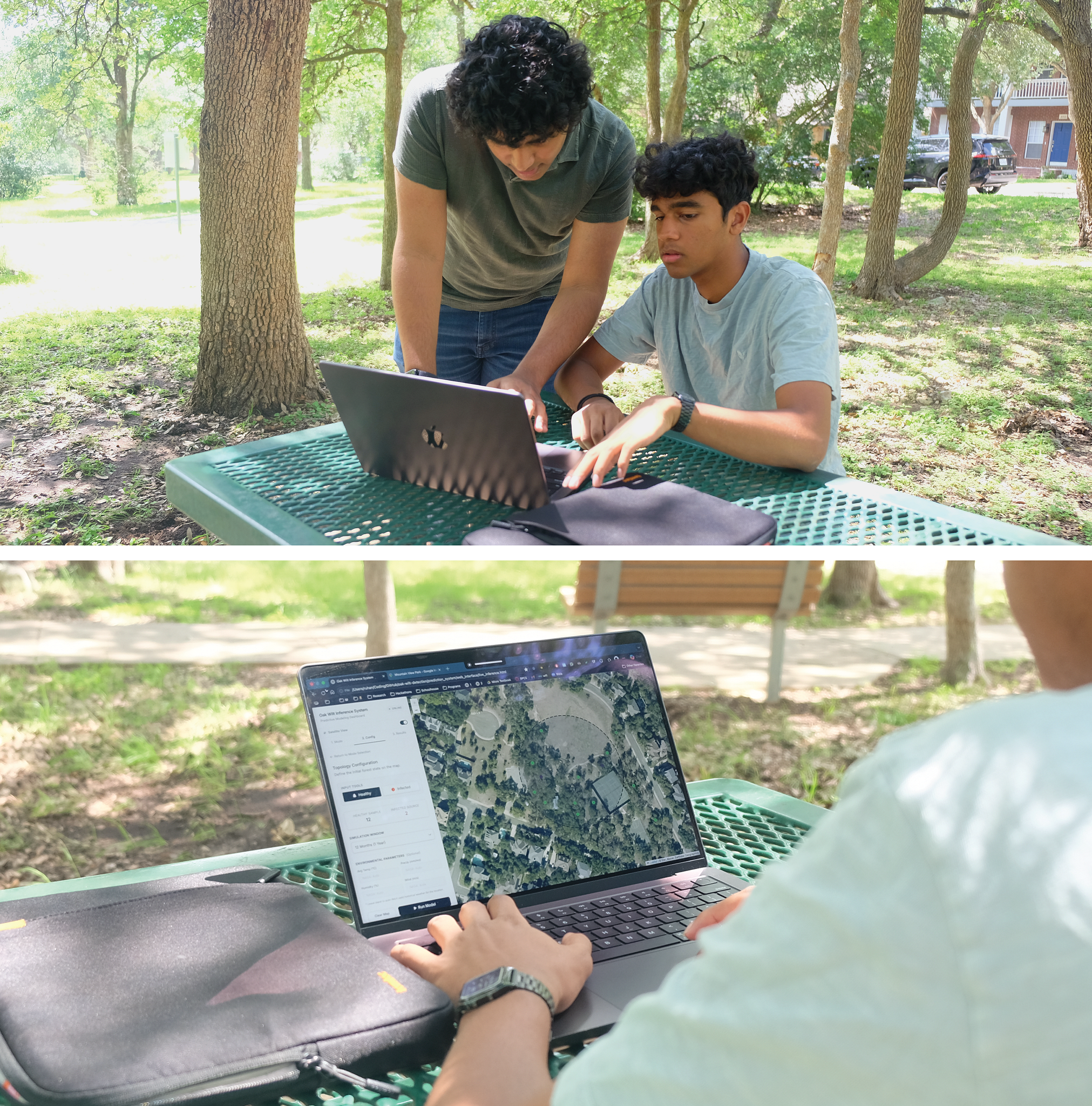
Varun: We started by reaching out to the City of Austin, which gave us access to their Oak Wilt Records Database. The database included timestamped, geolocated cases that we then filtered down to live oaks, since they're the dominant species in the area. From there, we pulled meteorological data from NASA's publicly available POWER API: wind speed, humidity, rainfall, and temperature. Those environmental factors are known to drive the spread of oak wilt by influencing both beetle activity and the formation of fungal mats, which are key to the disease's movement from tree to tree.
Ruhan: We were able to train our model on four decades of oak wilt case data paired with the corresponding environmental factors. We kept the core approach high-level and focused on building something arborists could actually use.
Varun: From what we’ve found, WiltCast has a 96.3% accuracy rate compared to historical validation. Arborists or community members who’d like to learn more about using the tool are invited to contact us through our website.
What’s been most rewarding about getting involved in this way?
Ruhan: The most rewarding part has been talking directly with the arborists and researchers whose work we could positively impact. We've connected with people from across the United States and locally here in Austin, learning how their day-to-day operations work and understanding what they actually need from a tool like this.
Varun: Another thing that’s been so rewarding is knowing that our skills are actually making a difference beyond just competitions or classrooms. I've spent a lot of time in competitive robotics, and while that has taught me a lot, this project feels different. It's saving real trees and helping arborists work more efficiently, saving them both time and money. There's something fulfilling about applying what we know to directly benefit the Austin community.
Ruhan: I’m also very proud of the recognition our work has received. Being named Net-Zero Heroes helps us share our project with our community, which benefits us all.
What’s been the toughest part?
Varun: The toughest part was capturing the true complexity of a biological pathogen in a model. Biological systems are messy, with prediction accuracy for pathogens considered good at around 75%, a much lower bar than the 85–90% you'd see in typical machine learning models.
Ruhan: Yes, definitely data. Getting reliable, healthy tree data is genuinely difficult because environments change so quickly. Trees grow and die, land use shifts, and there just isn't a great existing dataset on healthy trees like there is for confirmed infections. We had to use a technique called synthetic negative sampling to work around that gap.
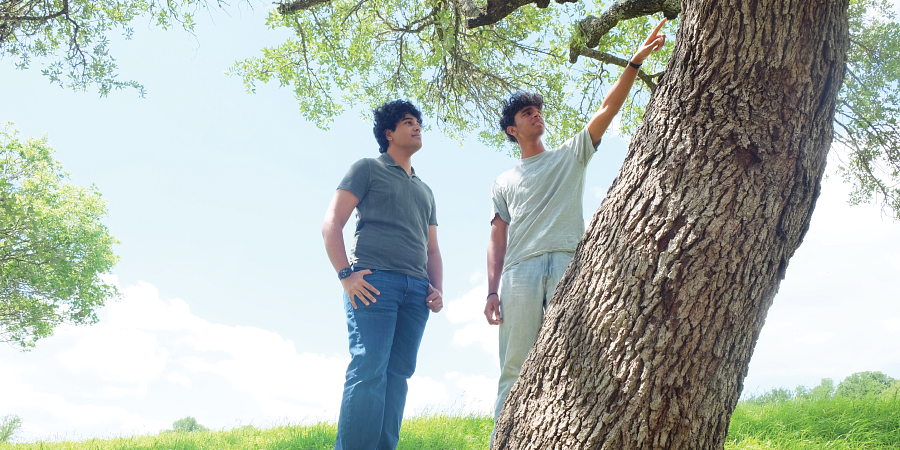
Varun: We had to go talk to people who actually understood the biological nuances and spatial data, who could tell us what factors we were missing and help us build something that reflected how oak wilt actually behaves in the real world. This included research scientists from Texas A&M and Harvard Universities, as well as one of the City of Austin’s very own senior geospatial analysts, Alan Halter.
Ruhan: Better data collection would go a long way toward increasing confidence in our results, and that could be improved with more funding and institutional support.
Can you tell us more about how you hope WiltCast will be used? How might arborists or neighborhoods interact with the platform?
Varun: We see WiltCast growing into a really comprehensive tool for anyone dealing with oak wilt. Beyond the predictive mapping already in place, we're actively working to expand the platform's capabilities.
Ruhan: In addition to the prediction and resource allocation capabilities, one thing that really struck me was a use case we hadn't originally anticipated. When we talked with senior leaders in the forestry and arborist space about their work, they described how WiltCast could serve as a visual communication tool. Beyond generating predictions, the app gives arborists an intuitive way to show landowners what's happening with the trees in their yard and what risks they face. By mapping out the disease spread vectors and animating how the infection will progress, arborists can have much more concrete conversations with residents about why action is needed and when. That takes our project beyond just technical novelty and into real community impact.
Varun: We’re also building out diagnostic support to help arborists determine whether a tree is infected, and broadening WiltCast's coverage beyond live oaks to include red and white oaks. The goal is for it to become a go-to resource that supports the full workflow.
Is there a book, documentary, or other piece of media you would recommend for folks wanting to learn more about these topics?
Ruhan: Check out our website at wiltcast.ruhangupta.com for more information about our project, demo videos, technical details, and contact info. Please don't hesitate to reach out if you have any questions or want to collaborate.
Varun: We’ll also be publishing a research paper later this year. Stay tuned on our website if you are a researcher curious about our work!
What advice do you have for others?
Varun: No problem is too big if you're willing to ask for help. When we first looked at oak wilt, it felt overwhelming, but reaching out to the right experts made it feel very achievable.
Ruhan: Pick a problem you know you can solve well. Look at your skills and honestly consider where you can apply them to make the biggest difference.
Varun: Yes, don't underestimate the importance of a well-rounded skill set. Technical skills will only get you so far. People skills, organizational skills, the ability to communicate and collaborate, all of it matters. Every type of skill plays its own role!
Ruhan: And beyond that, you need to be genuinely invested in the problem. If you don't care about it deeply, the work won't produce meaningful results. The reason WiltCast exists is that we lost a tree and wanted to make sure others wouldn't have to go through the same thing.
Dive deeper
Oak wilt impacts neighborhoods across Austin, and even healthy, cared-for trees can be infected. You can help slow the spread and save our oak trees by avoiding pruning oak trees from February through June each year and always painting oak wounds immediately. Learn more about oak wilt.
Want to see how you can support a vibrant and sustainable Austin? Visit the Austin Climate Equity Plan to discover more ways you can take action toward our community’s net-zero future!
Know a sustainability superstar?
Nominate them as a Net-Zero Hero by emailing Climate@AustinTexas.gov.