

In concert with the policy updates, Austin Police (APD) launched this webpage to help people understand their rights and provide links to resources available from the City of Austin and community organizations, such as Know Your Rights training. This webpage also includes information on the option of using APD Victim Services as an alternative to calling 9-1-1, when appropriate, and links to all general orders and policies related to immigration.
- Does APD have an Immigrant and Refugee Outreach point of contact?
-
Yes, the APDs Office of Community Liaison Office has an Immigrant and Refugee Outreach point of contact. The Office of Community Liaison (OCL) is comprised of professional staff that works closely with our sworn personnel to bridge the gap between the department and the community we serve.
Visit the Office of Community Liaison's Office website to get in touch with the point of contact.
- How can APD Victim Services be a resource for me?
-
At APD Victim Services, we are committed to supporting the safety and well-being of all crime victims, regardless of immigration status.
Our mission is to provide trauma-informed, victim-centered assistance while prioritizing privacy; APD Victim Services staff does not inquire about immigration status when delivering our services. Our main focus areas include:
- Safety
- Stabilization
- Connection to Resources
Our commitment
At APD Victim Services, our goal is to reduce harm, support healing and resilience, and ensure that families understand their rights and the resources available to them. Help is available to all victims regardless of immigration status, and we prioritize creating a safe environment for individuals to reach out and receive the support they need.
Who we support
Victim Services counselors are available to anyone affected by crime, regardless of immigration status. You can reach us at 512-974-5037. Our line is staffed during business hours, and after-hours and weekend counselors routinely check voicemail.
For urgent needs outside of business hours, please call 9-1-1 and ask for a Victim Services counselor to assist you. If you are reporting a crime, you can request that a counselor respond along with a patrol officer. If you speak Spanish, you may request a Spanish-speaking Victim Services counselor. For other languages, APD staff will provide interpretation services over the phone.
Confidential support
Counselors can speak with you privately before any police report is filed. They offer information about your rights, available resources, and the criminal justice process. Additionally, they can connect you with services such as:
- Legal aid
- Shelter
- Medical care
- Basic needs assistance
- Counseling
All of these resources are accessible even if you decide not to engage with law enforcement.
Support for families
When a parent or caregiver is detained or unavailable, APD Victim Services can assist by:
- Assessing the immediate safety and care needs of children or dependents
- Helping identify trusted caregivers or family support
- Providing crisis intervention and emotional support
- Connecting families to community organizations for legal, social, and basic-needs assistance
- Coordinating with child-serving systems and community partners to support family stability
Community collaboration
We work closely with trusted community and nonprofit partners that support immigrant families and those with varying immigration statuses. Our goal is to deliver assistance that is culturally respectful and sensitive to families’ needs.
Visit APD Victim Services Unit website for more information.
- What is APD’s revised general order related to ICE Administrative Warrants (Civil)
-
319.2.2 Warrant Hit and Confirmation states that if there is no other arrestable criminal charge for a person who has an ICE Administrative Warrant, the officer will notify their supervisor. To ensure compliance with Texas Gov’t Code section 752.053(b)(3) and to give direction to officers on how to handle ICE administrative warrants, the new general order provides that the officer or the supervisor may, but is not required to, contact the ICE Law Enforcement Service Center to validate the warrant. Officers cannot unreasonably prolong a detention to contact ICE. If ICE requests the officer detain the subject until ICE agents arrive, the officer or supervisor must contact the Watch Lieutenant who will determine if APD has sufficient resources at the time for the officer to remain on the scene. The Watch Lieutenant must consider several factors, including:
- The availability of APD resources and personnel that are appropriate for and trained to perform the requested task.
- Whether providing the requested assistance would assist with stopping criminal activity.
- Whether providing the requested assistance would affect potential criminal prosecution and/or stopping criminal activity, including the consideration as to whether the subject is a victim or witness of a crime.
- Whether providing the requested assistance would incur unreasonable overtime costs.
- The urgency of the request.
After evaluation, the Watch Lieutenant will contact and brief the Duty Commander, who will make the final decision on whether APD remains on scene.
318.3.4 Ice Detainer Requests and 330.9 Ice Detainer Requests Define what an ICE Detainer is and explain that it may be accompanied by an ICE Administrative Warrant.
- What policies does APD have related to immigration?
-
- APD General Orders – GO 330: Interactions with Foreign Nationals (pages: 239 – 249)
- APD General Orders – GO 607: U-Visa Nonimmigrant Status Certifications (pages: 505-507)
- APD General Orders – GO 318.3.3 - Request for Assistance from Federal Immigration (page: 198)
- APD General Orders – GO 318.3.4 - ICE Detainer Requests (page:199)
- APD General Orders – GO 318.3.5 - Maintenance and Sharing of Immigration Records (page: 200)
- APD General Orders – GO Consensual Encounters (page 201)
- What City Council Resolutions require APD to provide regular reports to Council?
-
Cite Eligible Custody Arrests
The purpose of this report is to provide an update on the Council resolution adopted on June 14, 2018, related to the Austin Police Department (APD) policies regarding the issuance of misdemeanor citations in lieu of arrest. The Council resolution requires APD to provide quarterly public reports to the City Council containing data on the use of arrests in lieu of citations for non-violent offenses when citation would be permitted by state law.
Online report: Council Resolution Reporting Requirements 20180614-73 & 74 | AustinTexas.gov
Immigration Enforcement
The purpose of this report is to provide an update on the Council directive adopted on June 14, 2018, related to immigration enforcement and information sharing. The directive requires the Austin Police Department to provide quarterly reports regarding the number of inquiries into someone’s immigration status, as well as the number of requests for assistance or cooperation made by ICE or other federal immigration officials.
Online report: Council Resolution Reporting Requirements 20180614-73 & 74 | AustinTexas.gov
- How can I find information regarding the City of Austin Equity and Inclusion Office?
-
Austin is committed to becoming the most livable city for all identities by fostering a culture of inclusivity and systemic change. This commitment is reflected in the City’s efforts to improve the quality of life for all Austinites.
Austin Equity and Inclusion (AEI) have three division within its office: Human Rights Division, Equity Division and Civil Rights division.
Visit the City of Austin Equity and Inclusion Office website to learn more about this office.
- How can I learn about U visas?
-
If you are wanting to learn more about U visas, you may contact APD’s Victim Services Unit at 512-974-5037.
To learn more about U Visas, visit https://www.uscis.gov/humanitarian/victims-of-criminal-activity-u-nonimmigrant-status.
- Who can I contact if I have questions?
-
You can contact APD Victim Services at (512) 974-5037.
- What is considered a valid form of identification?
-
A Government ID or Austin Public Library's (APL) Enhanced Library Cards are acceptable forms of ID. Here is how to obtain an APL Library Card: https://library.austintexas.gov/enhanced
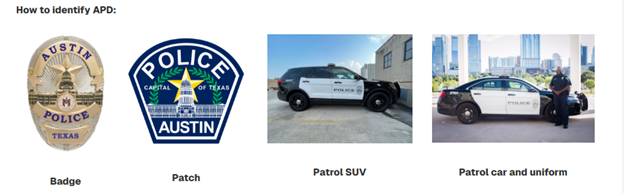
- How can you identify an APD officer and vehicle?
Additional Resources: