

June 1, 2026
September 29, 2026
June Updates
Spring Garden Greetings
In this edition of the Community Gardens Program Blog we have upcoming grant opportunities and deadlines, multiple bee related events, and our monthly Pollinator/Plant Relationship.
Education/Events
Austin School of Furniture is hosting a Solitary Bee Box Woodworking Class!
Saturday, June 20th, 2026 from 9am – 5pm, cost $115
A fun class with other bee lovers to build a home for solitary bees that are native to Texas. The materials for this project are included in the class.
Bee-O-Diversity: Meet Austin’s Native Bees Event
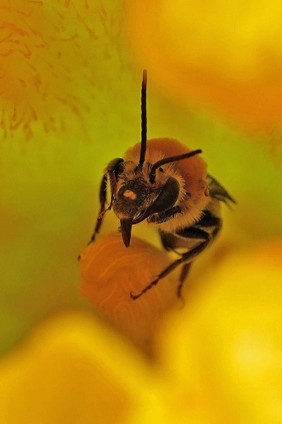
June 27 at 9:30 a.m.–12:00 p.m., Free with a Zilker Botanical Gardens Admissions
Location: Zilker Botanical Gardens
Presented by Lindsay Loftin of Austin Parks & Recreation’s Community Gardens Program.
Explore the amazing world of native bees! Learn about local species, what they need, and where to find them in the Zilker Botanical Garden.
Master Naturalist will table at the event. Get your first look at Austin Parks & Recreation’s newly curated display collection of Travis County’s common native bees. Be the first to take home the Bee City free seasonal planting guide for supporting local native bee diversity in your yard and community garden! Created in collaboration with Master Naturalists, the City of Austin Parks and Recreation Community Garden’s Program, and the Austin Nature and Science Center, this guide shows common native bees and which flowers they depend on by season. Many bees have a short emergence period of a few weeks to a few months as adults each year. For this reason, planting native and adapted plants which bloom during those emergence seasons is so important for native pollinators.
This class is geared toward adult learners but is open to participants of all ages. Your ticket purchase directly supports the mission of the Zilker Botanical Garden Conservancy, so please note the Garden does not provide refunds. Contact info@zbgconservancy.org with any questions. Photo credit to Deana Dossey, view her iNaturalist observation Pruinose Squash Bee from Heritage Hills, Austin, TX, USA on May 31, 2025 at 09:40 AM by Deana Dossey · iNaturalist.
Garden Grant Opportunities
Apply for a Food and Climate Equity (FACE) Grant
Austin Climate Action and Resilience is now accepting applications for the Food and Climate Equity Grant program to support community-led solutions created by those most affected by problems in the food system, environmental justice, and resilience!
The program offers grants of up to grants of $3,000 to support transformative change in the areas of food, climate, and resilience. Non-profits, schools, for-profit businesses, homeowner associations, faith-based groups, grassroots initiatives, and more are eligible to apply for a grant.
Any applicant that shares an intersectional lens and wants to build a more just, sustainable, and resilient future in Austin is encouraged to apply. Examples of funding projects could include projects that aim to address inequities in one or more of the project categories including Food Justice, Climate Justice, and Community Resilience. That could include community gardening projects that support neighborhood food access and knowledge
The program is accepting applications now through July 16, 2026. Learn more by visiting the Food and Climate Equity Grant program site. If you'd like support with your application please contact communitygardens@austintexas.gov for assistance.
Pollinator/Plant Relationship of the Month
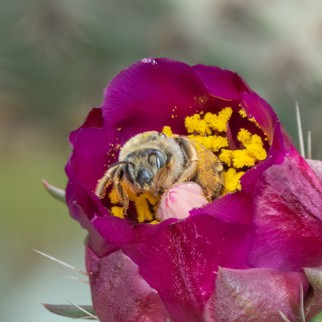
For June's Pollinator/Plant Relationship of the month we are offering something a little different. June is the month for both National Garden Week (June 7–13) and National Pollinator Week (June 22–28). For this month let's focus on the value native bees have as pollinators in Austin and around the world. One in three bites of food humans eat is created by the pollination of bees. Let that sink in. All pollinators are important, but if we look at the direct impact of bees they hold the largest key to the success of humans, as well as many plant species globally.
So, what makes bees so special? It's a few important differences. First, bees are the only pollinators which intentionally move pollen across the landscape. Many bees have special hairs all over their bodies specifically designed to trap pollen and collect it to use for provisioning their nests. This greatly increases the likelihood of pollination when bees visit plants. Second, some bees have a special way of getting pollen out of plants called sonication. Bumblebees vibrate their wings so quickly that it knocks pollen locked deep inside the flower out and onto the bee's body. Third, there are so many kinds of bees! Did you know there are over 20,000 known species of bees globally, over 4,000 species in North America, and over 800 species in Texas? That's a lot of bee-o-diversity. If you'd like to know more come see the new bee collection at the upcoming events in June!
If you'd like to volunteer to monitor bees in your garden, please email communitygardens@austintexas.gov to learn more. Photo credit to Mika Geiger, See more of Mika's observations on iNaturalist. Cactus chimney bees (Complex Diadasia australis) from 2220 Barton Springs Rd, Austin, TX 78746, USA on April 24, 2026 at 01:41 PM by Mika Geiger. Foraging on Cane Cholla cactus · iNaturalist
For more information on the Community Garden Program, or follow ups from the blog, contact communitygardens@austintexas.gov.