
Wildland-Urban Interface Code
Building and structures located within designated WUI areas are subject to requirements for site, infrastructure and structure hardening. Get started using this Guide to Projects in Austin’s Wildland Urban Interface (pdf)/Guía de Proyectos en la Interfaz Urbano-Silvestre de Austin (pdf).
This page lays out the four steps associated with development in the WUI:
- Step 1: WUI Project Criteria
- Step 2: WUI Zone Rules
- Step 3: Permitting Requirements
- Step 4: Inspections
- Additional Resources: Construction Guide | FAQs | Austin's WUI Code History (2015 WUIC)
For information about wildfire preparedness, safety and mitigation efforts in Austin and Travis County, visit Austin Fire's Wildfire Hub.

Step 1: WUI Project Criteria
The Wildland-Urban Interface has rules to protect buildings from wildfire. These ignition-resistant requirements change based on how close a structure is to the wildland.
- Proximity Zones
The WUI Code uses Proximity Zones to determine what requirements apply to a project.
Zone A: Structures located 50 feet or closer to the wildland
Zone B: Structures located greater than 50 feet and up to 150 feet from the wildland
Zone C: Structures greater than 150 feet and up to 1.5 miles from 750 acres or more of wildland; or
Structures greater than 150 feet and up to .5 miles from 40 acres or more of wildland
Once the proximity zone of a project is determined, the requirements for that zone can be applied.
- WUI Map
Use this Interactive WUI Code Map to determine a project's Proximity Zone. If in Zone A or B, confirm on site by measuring to the nearest wildland.
This WUI Code Training Video includes step-by-step directions about using the interactive map. The map instruction begins at time marker 51:43.
Step 2: WUI Zone Rules
Once a project's Proximity Zone has been determined using the Interactive WUI Code Map, apply the following resources to identify construction requirements.
- Guiding Documents
The 2024 International Wildland-Urban Interface Code (IWUIC) and the City of Austin's local amendments guide every building project.
Local Amendments (or on Municode)
Fire Protection Criteria Manual, Section 4.10
The abbreviation WUIC refers to the code and local amendments together.
This WUI Code Training Video provides additional details.
- Basic Requirements for All Zones
Always refer to the adopted code and amendments for full details.
Access, adequate driveways and/or fire lanes and roads | WUIC Chapter 4 [Amended]. 2024 IFC Chapter 5 [Amended] and Appendix B [Amended]
Water Supply, adequate hydrants and fire flow | WUIC Chapter 4 [Amended]. 2024 IFC Chapter 5 [Amended] and Appendix B [Amended]
Roof Repair or Replacement, replacement of 50% or more requires full replacement | WUIC 507.1 [Amended]
Ember Ignition Zone (EIZ)¸five-foot noncombustible zone around structures | WUIC 603.2.1 [Amended]
Spark Arresters, for chimneys | IWUIC 605
Generators and Similar Ignition Sources, alternative spark arrestor per USDA Forest Service Spark Arrester Guide | IWUIC A104.5
Outdoor fires, Barbecues, Grills, Fireplaces, 30 foot noncombustible zone and fire-resistive vegetation | IWUIC A104.7 and A104.8
- Zone A
In addition to basic requirements for all building and structures, the following regulations apply to structures within 0 to 50 feet of wildland (Proximity Zone A):
Ignition-Resistant Building Materials (30-minute test) | WUIC 503.2 [Amended]
Roofs | WUIC 504.2
Roof Covering | WUIC 504.2
Class A rated, gaps fire-stopped or covered with approved cap sheetRoof Valleys | WUIC 504.2.1 & 504.2.1.1 [Amended]
Valleys must have metal flashing over approved underlaymentSkylights | WUIC 504.2.2.2 [Amended] & WUIC 504.8,
Noncombustible frame and compliant glassNo Vegetative or Landscaped Roofs | WUIC 504.2.2.4 [Amended]
Other Roof Requirements | WUIC 504.2 [Amended]
Eaves (edge of roof) | WUIC 504.3 [Amended]
Soffits | WUIC 504.3.1 [Amended]
Ignition-resistant or other approved materials, unless it is also a ceilingNo Soffit Vents | WUIC 504.10.3 [Amended]
Fascia | WUIC 504.3.2 [Amended]
3/4-inch ignition-resistant material, or ignition-resistant material with 2x blocking or one-hour fire-rated backupExposed Rafter Tails | WUIC 504.3.4 [Amended]
Heavy timber rafter tails are allowed only with fire-rated walls and roof deckExterior Ceilings | WUIC 504.3.5 [Amended]
Ignition-resistant materialsGaps in Materials | WUIC 504.3.3 [Amended]
Ember resistant mesh with 1/8-inch openings
Gutters and Downspouts | WUIC 504.4 [Amended]
Noncombustible with leaf guards | WUIC 504.4 [Amended]Exterior Walls | WUIC 504.5
Ignition-resistant or other approved exterior facing materialsFlashing | WUIC 504.5.1
6-inch noncombustible flashing at wall-to-ground, -deck, or -roof intersectionsUnderfloor Enclosures | WUIC 504.6
Fully enclosed with approved materials unless protected by approved fire-rated or heavy timber materialsUnenclosed Appendage and Accessory Structures | WUIC 504.7 [Amended]
Decks, patios, pergolas and more shall be constructed with ignition-resistant or other approved materialsUnderfloor Enclosures over a slope | WUIC 504.7.1 [Amended]
Unenclosed appendages and accessory structures over slopes >10% must have the underside fully enclosed with approved skirting materialFences | WUIC 504.7.2 [Amended]
Ignition-resistant or other approved materials within 10 feet of buildingWindows | WUIC 504.8
Glass must be one of these: tempered, dual-pane (multilayer glazing), glass block, or 20-minute fire-ratedExterior Doors | WUIC 504.9
Doors must be one of these with any glass per WUIC 504.8: noncombustible, thick solid core wood, or 20-minute fire-ratedVent Openings | WUIC 504.10 [Amended]
Ember resistant mesh with 1/8-inch openings or WUI approved vents; see code for maximum size and location limitationsBoat Docks | WUIC 504.11.2 [Amended]
Noncombustible or ignition-resistant walking surfaces, Class A roof assembly
- Zone B
In addition to basic requirements for all building and structures, the following regulations apply to structures within 50 to 150 feet of wildland (Proximity Zone B):
Ignition-Resistant Building Materials (reduced 10-minute test allowed) | WUIC 503.2 [Amended]
Roofs | WUIC 505.2
Roof Covering | WUIC 505.2
Class A rated, gaps fire-stopped or covered with approved cap sheetRoof Valleys | WUIC 505.2.1 & 505.2.1.1 [Amended]
Valleys must have metal flashing over approved underlaymentSkylights, WUIC 505.2.2.2 [Amended] & WUIC 505.8 [Amended]
Noncombustible frame and compliant glassNo Vegetative or Landscaped Roofs | WUIC 505.2.2.4 [Amended]
Other Roof Requirements | WUIC 505.2 [Amended]
Eaves (edge of roof) | WUIC 505.3 [Amended]
Soffits | WUIC 505.3.1 [Amended]
3/4-inch solid material, or any Zone A option, unless it is also a ceilingNo Soffit Vents | WUIC 505.10.3 [Amended]
Fascia | WUIC 505.3.2 [Amended]
3/4-inch ignition-resistant material, or ignition-resistant material with 2x blocking or one-hour fire-rated backupExposed Rafter Tails | WUIC 505.3.4 [Amended]
Heavy timber rafter tails are allowed only with fire-rated walls and roof deckExterior Ceilings | WUIC 505.3.5 [Amended]
Ignition-resistant materialsGaps in Materials | WUIC 505.3.3 [Amended]
Ember resistant mesh with 1/8-inch openings
Gutters and Downspouts | WUIC 505.4 [Amended]
Noncombustible with leaf guards
Exterior Walls | WUIC 505.5
Ignition-resistant or other approved exterior facing materials
Underfloor Enclosures | WUIC 505.6
Fully enclosed with approved materials unless protected by approved fire-rated or heavy timber materials
Unenclosed Appendage and Accessory Structures | WUIC 505.7 [Amended]
Decks, patios, pergolas and more when located within 30 feet of a building shall be constructed with ignition-resistant or other approved materials
Underfloor Enclosures over a slope | WUIC 505.7.1 [Amended]
Unenclosed appendages and accessory structures over slopes >10% must have the underside fully enclosed with approved skirting material
Fences | WUIC 505.7.2 [Amended]
Ignition-resistant or other approved materials within 10 feet of building
Vent Openings | WUIC 505.10 [Amended]
Ember resistant mesh with 1/8-inch openings or WUI approved vents; see code for maximum size and location limitations
Boat Docks | WUIC 505.11.2 [Amended]
Noncombustible or ignition-resistant walking surfaces, Class A roof assembly
- Zone C
In addition to basic requirements for all building and structures, the following regulations apply to structures within 150 feet to 1.5 miles from 750 acres or more wildland; or structures within 150 to .5 miles from 40 acres or more wildland (Proximity Zone C):
Ignition-Resistant Building Materials (reduced 10-minute test allowed) | WUIC 503.2 [Amended]
Roofs | WUIC 506.2 [Amended]
Roof Covering | WUIC 506.2 [Amended]
Class A rated, gaps fire-stopped or covered with approved cap sheetRoof Valleys | WUIC 506.2.1 & 506.2.1.1 [Amended]
Valleys must have metal flashing over approved underlaymentSkylights | WUIC 506.2.2.2 [Amended] & WUIC 506.7 [Amended]
Noncombustible frame and compliant glassNo Vegetative or Landscaped Roofs | WUIC 506.2.2.4 [Amended]
Other Roof Requirements | WUIC 506.2 [Amended]
Eaves (edge of roof) | WUIC 506.4 [Amended]
Soffits | WUIC 506.4.1 [Amended]
3/4-inch solid material, or any Zone A option, unless it is also a ceilingFascia | WUIC 506.4.2 [Amended]
3/4-inch ignition-resistant material, or ignition-resistant material with 2x blocking or one-hour fire-rated backupExposed Rafter Tails | WUIC 506.4.4 [Amended]
Heavy timber rafter tails are allowedExterior Ceilings | WUIC 506.4.5 [Amended]
Ignition-resistant materialsGaps in Materials | WUIC 506.4.3 Amended
Ember resistant mesh with 1/8-inch openings
Gutters and Downspouts | WUIC 506.4.6 [Amended]
Noncombustible with leaf guardsUnderfloor Enclosures | WUIC 506.3
Fully enclosed with approved materials unless protected by approved fire-rated or heavy timber materialsUnenclosed Appendage and Accessory Structures | WUIC 506.6 [Amended]
Decks, patios, pergolas and more when located within 10 feet of a building shall be constructed with ignition-resistant or other approved materialsFences | WUIC 506.6.1 [Amended]
Ignition-resistant or other approved materials within 10 feet of building or structure Exception: within 5 feet of Residential Code building or structureVent Openings | WUIC 506.5 [Amended]
Ember resistant mesh with 1/8-inch openings or WUI approved vents; see code for maximum size and location limitationsBoat Docks | WUIC 506.8.2 [Amended]
Noncombustible or ignition-resistant walking surfaces, Class A roof assembly
- Approved Materials and Vegetation
The WUI Approved Materials List (AML) includes materials that have been verified to meet the WUI Code requirements.
The WUI Vegetation Guide lists plants recommended five feet or more from a structure. It also includes plants that are suitable within 30 feet of an ignition source such as grills, fireplaces, fire pits, generators, & other heat or spark‑producing equipment.- Video Training Presentation
This WUI Code Training Video summarizes the code adopted by the City of Austin. Watch the presentation in its entirety or use the bookmarks to jump to specific topics.
Step 3: Permitting Requirements
- Permitting Requirements
Check the Do I Need a Permit webpage to determine if a project needs a permit. Even if a permit is not needed, the work still must follow WUI Code requirements.
Work Exempt from WUI Code Chapter 5
All work on a building, structure, or premise in the WUI must comply with the WUI Code. This includes construction, alteration, movement, repair, maintenance, and use of the structure.
However, the work below does not have to follow Chapter 5, as listed in Section 501.1:Accessory structures that are 100 square feet or smaller and are more than 50 feet away from the nearest structure.
Agricultural buildings that are more than 50 feet away from the nearest structure.
These structures must follow all other chapters. Including access, water supply, an Ember Ignition Zone, and protection surrounding outdoor fires.
Jurisdiction and Applicability
The WUIC applies to properties in the City of Austin Full Purpose or Limited Purpose (LTD) areas. It does not apply to properties fully in the extraterritorial jurisdiction (ETJ). Properties located within more than one jurisdiction are subject to WUIC requirements. The extent of required compliance will be reviewed on a case-by-case basis.- Application Submittal Requirements
The following checklists outline the documents needed as part of the WUIC Plan Review:
- Residential Plan Review Submittal Checklist (pdf)
- Commercial Plan Review Submittal Checklist (pdf)
- Site Plan Review Submittal Checklist (pdf)
- Subdivision Plan Review Submittal Checklist (coming soon)
- Fire Hazard Severity Form & Guide (pdf), applicable to properties in a limited access community
- Plan Submission Requirements
Clear, complete details help City staff verify the work meets the rules. Contractors can then install the right materials.
To avoid confusion, delays, and costly construction changes, plans must clearly show:Exact product details: manufacturer name, product model or number, and fire test data for each material.
Fictional example: “StoneHaven StrataBoard Horizontal Siding, ASTM E84 Class A”
Where materials are used: label materials in wall sections, elevations, floor plans, and roof plans. Another option is to list them in a materials schedule.
Code references with product information: if listing a code section (example: WUIC 504.7), identify the specific product that meets it.
Providing a WUI Detail Drawing Sheet and WUI Materials Schedule is optional. They can consolidate information in one place for easy review, construction, and inspection.
For more guidance, follow the Guide to WUIC Drawing Details.
Download a WUI Materials Schedule template to get started:
Step 4: Inspections
- Inspection Resources
All classes of ignition-resistant construction require two WUI inspections. Materials installed in the field must match approved materials shown on the plans. The inspector will verify this on-site.
Inspection 1: Coordinate at or just before scheduling the building frame inspection. The frame cannot be covered until the fire inspection has been satisfactorily completed.
Inspection 2: Schedule after the structure is complete and ready for a building final. The WUI final must be completed prior to the building final.
The following links provide additional inspection information
Inspection times vary based on demand and staff availability. Inspections must be scheduled at least 48 hours in advance. Planning a week ahead, especially during busy periods, is recommended.
WUI Construction Guide
The following sections provide guidance on specific building elements that require additional protection in the wildland-urban interface. For a more complete list of requirements, please consult Step 2: WUI Zone Rules.
- Know Your Risk
Austin was the first major city in Texas to adopt the International Wildland-Urban Interface Code. The initial code, which was adopted in 2020, was revised in 2024 to reflect new understanding of wildfire vulnerabilities and protections.
Under the updated code, more than half of Austin falls into one of three WUI Code zones (A,B and C) which each have site, infrastructure and structure hardening requirements.
Use the 2024 WUI Code Interactive Map to determine whether your property is included in the wildland-urban interface, and if so, which zone.
- Eaves
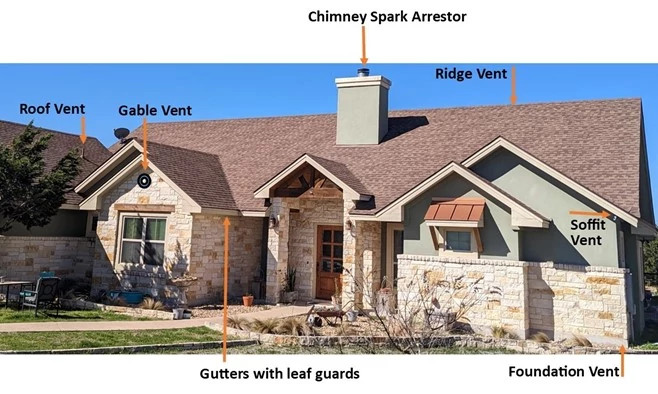
Roof construction requirements are similar in Zones A, B, and C, except when working on eaves. The 2024 WUI Code allows many ignition-resistant options for eaves, however, there are simple options that work in all zones:
- Soffits & Outdoor Ceilings: use fiber cement, stucco, or metal.
- Fascia: Use fiber cement, stucco, or metal. Back up fascia with continuous 2x lumber.
- No soffit vents, except in Zone C.
- In Zone C, perforated fiber cement soffits are also allowed with 1/8” ember mesh behind them.
- Always select ignition-resistant materials for eaves
- Vents
Wildfires can spread when embers land on roofs or blow into vents, causing wood and other flammable material to catch fire, which puts homes and other structures at risk.
Ventilation openings that require protection include bathroom exhaust vents, HVAC air intakes, attic vents, underfloor vents, exterior wall vents, and others.
- Cover openings with non‑combustible, corrosion‑resistant mesh (openings ≤ 1/8”).
- Attic vents cannot be in soffits, eaves, or rafters (except Zone C soffit vents with ember mesh).
- Gable and dormer vents must be 10 feet from the lot line.
- Vent size cannot exceed 144 square inches.
- Do not use window screen material because it melts in fire. Look for galvanized or stainless-steel hardware cloth, or ember protection mesh made specifically for use in the WUI.
- Ember mesh is not required at dryer vents or plumbing vents; however dryer vents must be metal with metal ductwork.
- Roofing & Roofing Valleys
A Class A roof assembly is required. This is the highest fire rating for a roof assembly or covering. Once a roof covering is selected, ensure with the manufacturer that the underlayment, insulation, and sheathing is sufficient for the Class A fire rating
- Roof covering = material you see on the exterior such as shingles, metal, and clay tile.
- Roof assembly = covering + deck + underlayment/insulation, all tested together for fire resistance.
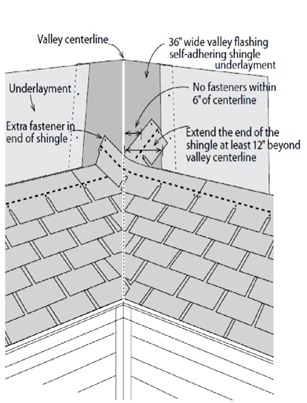
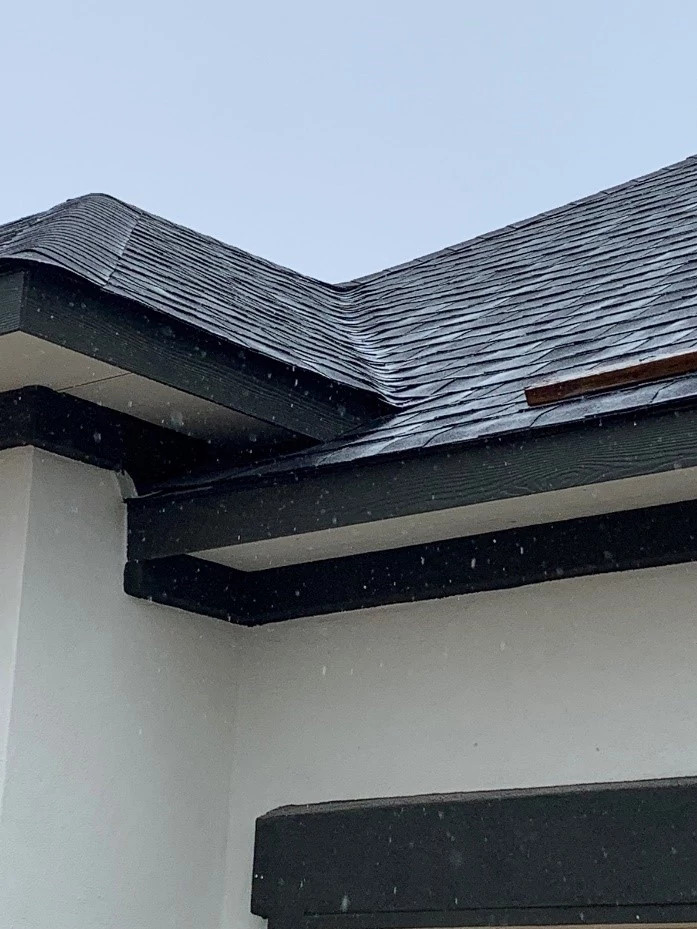
Roof valleys must use metal flashing or a woven valley (closed valley). Flashing must meet IWUIC standards and be visible for inspection.
Metal Valley Flashing: 0.019 inch (0.48 mm) (No. 26 galvanized sheet gage) corrosion-resistant metal installed over a minimum 36-inch wide (914 mm) underlayment consisting of one layer of 72-pound (32.4 kg) mineral-surfaced, non-perforated cap sheet complying with ASTM D3909 running the full length of the valley.
Woven Valley: Valley shingles that have been weaved or woven (closed valley) to create a continuous layer of shingles over the valley may be flashed using 26 gage (0.019 inch) galvanized sheet metal running the full length of the valley and extending at least 12 inches on both planes of the roof surface. Flashing shall be viewable from the end of the valley at the roof eave for inspections.
- Gutters
Gutters and downspouts shall be constructed of non-combustible materials with non-corrosive and non-combustible leaf guards to prevent the accumulation of leaves and debris.
- Chimneys
Chimneys serving fireplaces, chimineas, barbecues, outdoor pizza ovens, incinerators, or decorative heating appliances must have a spark arrestor constructed of woven or welded wire screening equivalent to 12 USA standard gage (SWG) wire (0.1046 inch) (2.66 mm), 19 SWG galvanized wire (0.040 inch)(1.02 mm), or 24 SWG stainless steel wire (0.022 inch) (0.56 mm) having openings not exceeding 1/2 inch (12.7 mm). See Appendix A in the WUI code for other requirements for outdoor heating and cooking elements.
- Fences
Wildfires spread through flames, heat, and flying embers. A wooden fence can act like a fuse, carrying fire straight to the home or building.
Fence construction requirements are similar in Zones A, B, and C. To protect your property, build fences and fence segments located within 10 feet of a house or other structure with fire resistant materials. Options include: non‑combustible materials (like metal or masonry, naturally fire-resistant hardwoods and fire-resistant materials that meet code standards.
Many fire‑resistant fence options, like the examples below, are available at home improvement stores, online, or through contractors.
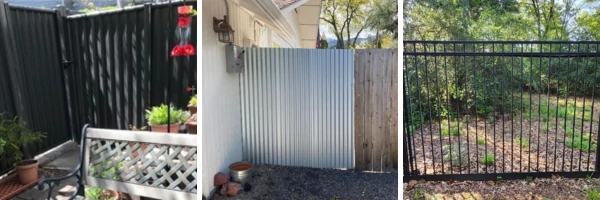
Steel Privacy Fencing | Corrugated Metal Fencing | Wrought Iron Fencing
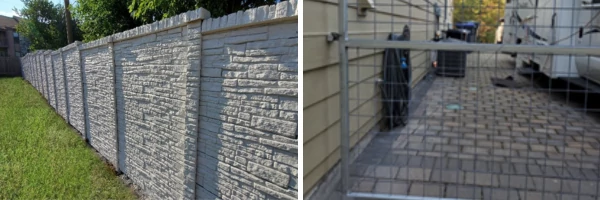
Concrete or Stone Fencing | Steel Wire Fencing
Please note:
- Fire-retardant paints, coatings, or stains do not provide permanent fire resistance and are not allowed.
- Find out more in the Fences FAQ
- Some materials may not be permitted in Zone A.
- See our WUI Approved Materials List of pre‑approved materials.
FAQs
- Retroactivity
Do existing buildings in the Wildland‑Urban Interface (WUI) have to be updated to meet the current WUIC?
No. New construction or development started on or after January 1, 2021, is required to comply.
The 2024 WUIC only applies to new construction or development that starts on or after July 10, 2025. This includes permit applications submitted on or after that date.
Existing buildings do not need to be changed. Except when a code official determines they are a serious safety hazard.- WUI Map
Will the map eventually show three different colors for Zones A, B, and C?
No. Zones A and B are shown together on both the 2024 WUI Code Interactive Map and the Property Profile Map. The map is meant to help applicants get started, but cannot replace the process of verifying a site.
To find out which Proximity Zone applies, measure the distance from the structure to the wildland using the tools on the map. Confirm conditions directly on the site.
If still unsure after checking both the map and the site, please Email us for assistance.- Changes to Approved Site Plans
Do approved Site Plans have to be updated for the 2024 WUIC?
No. Site Plans approved under the 2015 WUIC or earlier do not need to be changed for the 2024 WUIC for siterelated items such as:
• 106.7 Vicinity Plan
• 402.2 Access and Water Supply for Individual Structures
• 403 Access
• 603 Defensible Space
• 603.2.1 Ember Ignition Zone (EIZ)However, any modification that adds a new structure, adds a new unit, or increases a building’s fire area must meet the updated rules for the revised portion.
Permits submitted on or after July 10, 2025, must meet the 2024 WUIC. Previously approved site elements may remain under the old code.- Volume Builder Program Participants
Do Volume Builder Master Plans need to be updated for the 2024 WUIC?
Master Plans submitted before July 10, 2025, may continue using the 2021 Residential Code and 2015 WUIC for that section or phase. New sections or phases requiring a new Master Plan must follow the 2024 technical codes.Master Plans submitted on or after July 10, 2025, must meet the 2024 codes. Older prototype plans cannot be reused unless updated.
WUI Vicinity Plans approved under the 2015 WUIC may still be used for new phases in the same subdivision unless changes affect how close structures are to wildland areas.
If only a portion of a PUD had a WUI Vicinity Plan, new plans are needed for other sections unless covered by the approved PUD agreement.- Ember Ignition Zone
How far from the EIZ should a new tree be planted?
All parts of a new tree, including its expected full-grown canopy, must be outside the EIZ.
Existing heritage or protected trees may stay and should be maintained per LDC and ECM rules.Why aren't vegetative roofs allowed in the WUI?
Green roofs can increase wildfire risk because plants can catch embers and burn. The WUI Code focuses on reducing fuel near buildings and creating noncombustible space to protect people, homes, and fire crews.What is a vegetative roof?
A vegetative roof is a roof system that includes plants as part of its design.See the International Building Code (IBC) and International Fire Code (IFC) Section 202 for a full definition.
How do EIZ rules work with impervious cover requirements?
Both permeable and impermeable surfaces are allowed. Gravel is a common permeable option.
In Zone C, closely mowed green grass is also allowed under a specific exception.Can a weed barrier be added under gravel in the EIZ?
Yes, as long as it is fully covered by gravel or another noncombustible material.Is there a restriction on gravel type?
No, although some projects may have other code requirements that affect gravel size.Does the EIZ have to extend onto a neighbor’s property?
No. The EIZ stops at your property line.
Can other perennial grasses besides Rye be used in Zone C?
Possibly. Alternatives for review may be submitted as an Alternative Method of Compliance.
Can green grass be used in Zone B?
No. Green grass is only allowed in Zone C, where buildings are at least 150 feet from wildland areas.
What landscaping items are allowed in the EIZ?
Examples include gravel, pavers, concrete, metal or concrete furniture without cushions, stone décor, bird baths, and other noncombustible items.
- Exterior Walls
Are 1-hour fire rated exterior walls required in Zones A and B?
A 1-hour wall is one of the approved options where the exterior finish is ignition-resistant. Most projects use either noncombustible or ignitionresistant materials.Zone B follows the same rules as Zone A to match the model code.
- Decks & Appendages
What materials can be used for deck structures since ground contact fire retardant treated wood isn’t available?
Heavy timber, metal, steel, masonry, or cement-based materials can be used for deck framing. Some naturally durable wood species that are fire retardant treated may also be acceptable.
Standard exterior wood framing can be used if the entire underside of the deck is fully enclosed with ignition-resistant skirting. With this option, there can be no storage or access openings under the deck. If equipment below the deck needs access, there must be an ignition-resistant alcove so that, even if a door is left open, all surfaces inside that space are ignition resistant.Can a 6x6 wood post be used for a patio cover?
No, a plain 6x6 post does not meet WUI requirements. Posts must either meet heavy timber size requirements, be fire retardant treated for exterior use, or be wrapped in an ignition-resistant material. Approved naturally fire-resistant hardwoods may be used in Zones B and C.
- Fences
How is fence distance to a building measured?
Measure from the outer face of the building wall (or appendage) to the nearest face of the fence.What if a new building is placed close to an existing noncompliant fence?
The fence should be brought into compliance. If that isn’t possible, either:
• the nearby wall and eave must be 1-hour fire rated and ignition resistant, or
• all exterior wall and eave materials must be fully noncombustible.- Windows & Doors
Do windows and doors have to meet every requirement in WUIC 504.8 and 504.9?
No. They only need to meet one of the listed compliant options unless additional upgrades are required for hazard mitigation.Do window and door frames have special requirements?
Window and door frames may be any material allowed by the Building or Residential Code. Skylight frames must be noncombustible.Only the glazing and door construction must meet WUIC 504.8 and 504.9.
Archive: Austin's WUI Code History
- Austin's WUI Code History
Austin was the first major city in Texas to adopt the International Wildland-Urban Interface Code. Use the table to seewhich version of the WUIC applies to a project.
Application Submission Date Applicable Code Details January 1, 2021 – July 9, 2025 Amended 2015 International Wildland-Urban Interface Code Adopted April 9, 2020. Took effect on January 1, 2021.
On or after July 10, 2025 Amended 2024 International Wildland-Urban Interface Code Adopted April 10, 2025. Took effect on July 10, 2025.
- Austin WUI Code Archive
2015 WUI Code Resources, effective July 1, 2021 - July 9, 2025:
- 2015 Wildland-Urban Interface Code Ordinance (local amendments)
- 2015 International Wildland-Urban Interface Base Code
- WUI Code Map
- ARCHIVE - 2015 WUI Proximity Zones - Guide to Construction
- ARCHIVE - 2015 Wildland-Urban Interface Approved Materials List
- Fire Protection Criteria Manual, Sections 3.2.12 and 4.10
The Wildland-Urban Interface Code provides current and historical information about Austin's WUI Code and related resources.