

Historic Landmarks

What is a local historic landmark?
Historic landmarks tell the stories of Austin’s growth and change. To be eligible for landmark designation, a building must be at least 50 years old, retain historic integrity, and meet two of five criteria for significance:
- Architecture
- Historical associations with important people, groups, or events
- Archaeology
- Community value
- Landscape feature
Explore the Historic Property Viewer to view Austin’s designated historic landmarks.
Historic Landmark FAQs
Owning a historic landmark comes with benefits and responsibilities.
- Inspections: Landmarks are regularly inspected by Historic Preservation Office staff to support good stewardship. Properties that do not meet the landmark maintenance standards will not be eligible to receive the partial tax exemption.
- Project Review: Exterior site and building changes require historic review and approval by the Historic Preservation Office or Historic Landmark Commission, with the exception of routine maintenance and in-kind repairs. Projects must comply with the Historic Design Standards. Learn more about historic review.
- Tax Benefit: Historic landmark owners can receive an annual partial property tax exemption. The property owner or agent must file a historic property tax exemption form with the Travis Central Appraisal District (TCAD) by April 30 every year for TCAD to grant the exemption. For more information, contact TCAD at 512-834-9317. The City of Austin does NOT provide exemption forms or process applications.
Eligibility
To be eligible for designation as a historic landmark, a building must be least 50 years old, retain historic integrity, and meet at least two of five criteria for significance:
- Archaeology
- Architecture
- Historical associations with important people, groups, or events
- Community value
- Landscape feature
Application Process
The application process for historic zoning involves several key steps. Below, see the historic zoning process chart (or view full size image here) and read more for further detail on the application process.
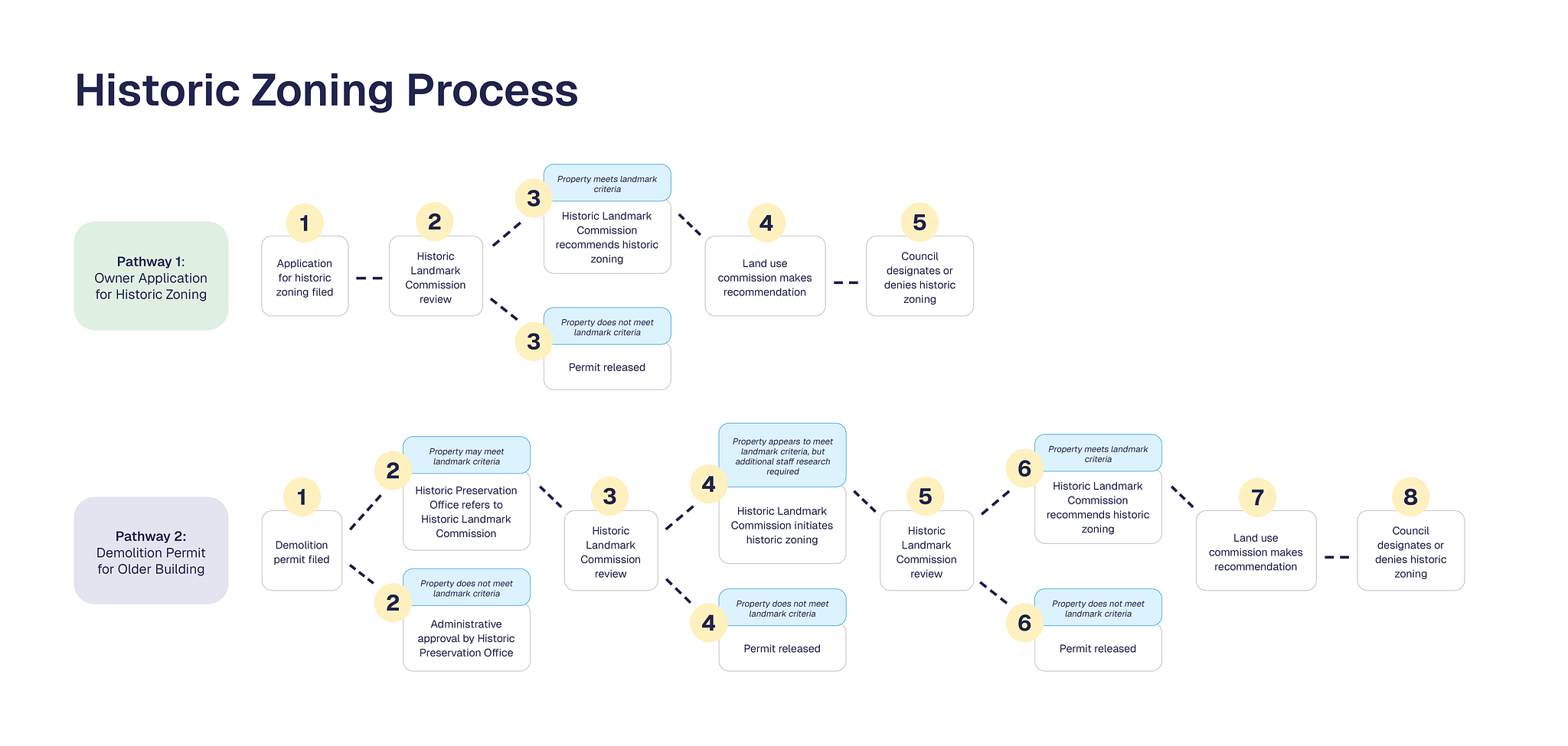
Completing the Historic Landmark Application: If your property meets the eligibility criteria, fill out a historic zoning application. For assistance, reach out to Historic Preservation Office staff. If you aren’t sure whether your building meets the eligibility criteria, the Research Guide (guía en español) provides guidance on researching buildings and neighborhoods.
Application Review: Once you submit your application, the review process begins. A historic landmark application is reviewed by the Historic Landmark Commission approximately four to six weeks after application submittal. The application is then reviewed by either the Planning Commission or the Zoning and Platting Commission, and finally by the City Council.
Responsibilities and Benefits: Like all other property owners, historic landmark owners are responsible for maintaining their properties. Changes to historic landmarks must go through historic review, and landmarks are inspected to ensure they are being maintained. An annual partial tax exemption supports good stewardship. For details, see the I own a historic landmark section above.
Annual Inspections and Partial Tax Exemptions for Historic Landmarks
Historic Landmark Inspections
Inspections assist historic landmark owners in maintaining important buildings. Early identification of potential issues helps avoid more costly future repairs and ensures that places reflecting Austin’s rich history are around for generations to come.
- Inspections occur from September through December every year.
- Inspections are not scheduled in advance, and a property owner does not need to be on site during inspections.
- Historic Preservation Office staff visually inspect and photograph building exteriors from all sides.
- Inspections occur regardless of whether a property owner applies for the historic landmark tax exemption.
The Historic Landmark Inspection Standards are used to evaluate compliance with maintenance code provisions. If a property fails inspection, the Historic Preservation Office will contact the owner or agent. The property will be ineligible for the historic landmark tax exemption until repairs are made.
How to Apply for the Historic Landmark Tax Exemption
The property owner or agent must file a historic property tax exemption form with the Travis Central Appraisal District (TCAD) by April 30 every year for TCAD to grant the exemption. For more information, contact TCAD at 512-834-9317. The City of Austin does NOT provide exemption forms or process applications.
Exemption Approval Process
Every March, the Historic Landmark Commission evaluates eligibility for the historic landmark exemption based on inspection results and designation dates, then forwards their recommendations to TCAD and Austin City Council for adoption in the City’s annual budget. TCAD processes exemption application forms after the April 30 deadline, and may request evaluations from other taxing entities, including the Austin Independent School District (AISD) and Travis County/Travis County Healthcare District.