
Pedestrian Program
Pedestrian Focus Areas
Ensuring everyone in Austin feels safe and included when moving around our streets is a top priority in the Austin Strategic Mobility Plan. That's why the City of Austin focuses resources on building out our sidewalk network, developing pedestrian crossings and other programmatic efforts to improve the comfort, safety and connectivity of our city's pedestrian network.
Pedestrian Crossings
Pedestrian crossings address pedestrian safety and comfort at locations where different modes of travel intersect and where the risk of crashes or conflicts is highest. City data shows that creating pedestrian crossings in convenient locations improves road safety. Crashes that occur farther from signalized crossings, such as traffic signals or pedestrian hybrid beacons (PHBs or crosswalk signals), are more severe. Crashes occurring more than a half-mile away from the nearest signalized crossing resulted in serious injury or fatality 43% of the time, compared with only 22% of the time if the crash occurred within one-eighth of a mile of a signal.
Program Funding
Austin's Mobility Bonds support safer street crossings across the city. The 2018 Mobility Bond dedicates $15 million to intersection and pedestrian safety projects, including $4 million for the Pedestrian Crossing Program. The 2020 Mobility Bond allocates $65 million for safety and conflict‑reduction projects, including $4.1 million for pedestrian crossings.
View Pedestrian Crossing Prioritization Map
Pedestrian Crossing Treatments
- High-Visibility Crossings
High-visibility crossings improve a driver’s awareness of a pedestrian crossing through a striping design, which includes continental crosswalk markings. These enhancements are generally appropriate on all streets but higher-speed streets require additional treatments to provide the needed level of safety.
- Crossing Islands
Crossing or pedestrian refuge islands provide a protected space for pedestrians to stand and wait in the middle of a two-way street. Crossing islands are generally appropriate on all street levels and should be considered with signalized treatments for Level 3 and 4 streets with high travel speeds.
Read the Transportation Criteria Manual
- Curb Extensions
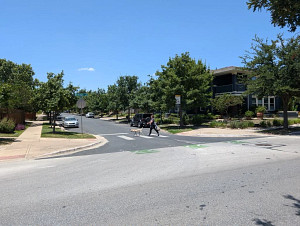
Curb extensions or bulb outs, extend the sidewalk into the street to reduce the distance of the crossing, limiting the exposure of crossing pedestrians and enhancing the sight distance between pedestrians and motorists. Curb extensions are good candidates for locations with existing parking lanes and should be used in combination with other countermeasures. Curb extensions are generally appropriate on all street levels within the guidelines of the Transportation Criteria Manual.
- Raised Crossings
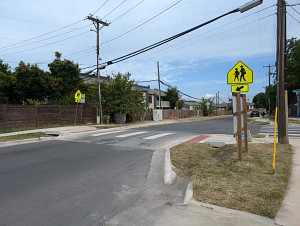
Raised crossings are ramped speed tables spanning the entire width of the roadway, often placed at mid-block crossing locations. Raised crossings are particularly useful around schools where children are expected to cross frequently.
Read the Transportation Criteria Manual
- Grade Separation
Grade separation refers to building a pedestrian bridge or tunnel to fully separate people crossing from moving vehicles on a multi-lane street or a controlled-access highway. Grade separation can eliminate the conflicts associated with crossing such facilities.
- Pedestrian Hybrid Beacons (PHB)
Pedestrian hybrid beacons (PHB) include one yellow and two red lenses on a signal pole to stop traffic when pedestrians are present. PHBs are activated by a pedestrian push button or pedestrian detection. PHBs are generally appropriate on Level 3 and 4 streets.
Read the Transportation Criteria Manual
- Rectangular Rapid-Flashing Beacons (RRFB)
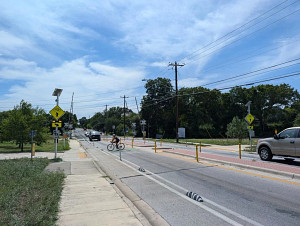
Rectangular Rapid-Flashing Beacons (RRFB) are rectangular-shaped yellow light indicators that flash when a pedestrian activates it via pushbutton or pedestrian detection. These are typically used with a crossing warning sign and are placed on both ends of the crossing and potentially on the crossing island (if present). RRFBs are generally appropriate when crossing islands can't be installed.
Read the Transportation Criteria Manual
- Other Signal Solutions
Countdown timers, Accessible Pedestrian Systems (APS) and Leading Pedestrian Intervals (LPI) are among several solutions that support safer and more predictable crossings at signalized intersections.
Accessible Pedestrian Systems (APS) are integrated pedestrian signal features that provide audible, tactile, and visual cues to help people with disabilities—especially those with visual or hearing impairments—safely navigate street crossings. APS devices typically include audible walk indications, vibrating pushbuttons, and Braille or raised‑letter information to ensure equitable access at signalized intersections.
Leading Pedestrian Intervals (LPI) give pedestrians a head start at signalized intersections by displaying the cross signal several seconds before vehicles receive a green light. This early phase increases visibility, reduces conflicts with turning vehicles, and improves safety for people crossing the street.
Requesting or Reporting a Pedestrian Crossing
To report an issue or request a new pedestrian crossing, contact Austin 3‑1‑1. All requests are reviewed and prioritized using the Sidewalks, Crossings, and Shared Streets Plan.
Current Pedestrian Projects
Learn about pedestrian improvement projects underway in Austin and opportunities to provide feedback.
Guadalupe Street (46th–51st streets) Pedestrian Crossing Islands
The City of Austin is proposing pedestrian crossing islands along Guadalupe Street between 46th and 51st streets. Visit the project webpage to learn about the planned improvements and share your feedback.
View the Guadalupe Street Pedestrian Crossing Islands project
ADA Transition Plan Updates
Austin Pedestrian Crossings ADA Transition Plan
This plan evaluates Austin’s pedestrian crossings to identify barriers such as steep curb ramps, missing or inaccessible push buttons, and poor crosswalk conditions. It outlines a 10‑year strategy to upgrade curb ramps, signals, markings, and maintenance practices, improving safety and accessibility for all users.
Community Input
The City's volunteer Pedestrian Advisory Council, advocacy groups and diverse Austinites and groups actively help to shape our work. On individual projects, a public process invites neighborhood and stakeholder input. It includes people traveling as pedestrians with wheelchairs, scooters, or other assistance. The City is continuously upgrading sidewalks, ramps, and the pedestrian network to make it ADA-accessible.
Featured Video
Have you ever wondered whose voice you hear when you push a signal button? We introduce you to Austin Transportation and Public Works' Lupe Alvarado, the person behind most of Austin’s voice-guided signals and a growing population that depends on this guidance every day.
Related Resources
Adopted in 2023, the plan focuses on the management and expansion of sidewalks, shared streets, and pedestrian crossing infrastructure and serves as the ADA Transition Plan for City of Austin sidewalks within the public right-of-way.
Vision Zero is Austin's commitment to eliminating traffic deaths and serious injuries on our roadways. By designing safer streets, using data to guide public policy, supporting targeted enforcement, and engaging our community, we're building a transportation system where everyone can travel safely.
Austin's Bicycle Program works to make Austin an even greater city for biking. Our work is guided by the 2023 Austin Bicycle Plan.
Adopted in 2023, the plan focuses on the management and expansion of sidewalks, shared streets, and pedestrian crossing infrastructure and serves as the ADA Transition Plan for City of Austin sidewalks within the public right-of-way.
Vision Zero is Austin's commitment to eliminating traffic deaths and serious injuries on our roadways. By designing safer streets, using data to guide public policy, supporting targeted enforcement, and engaging our community, we're building a transportation system where everyone can travel safely.
Austin's Bicycle Program works to make Austin an even greater city for biking. Our work is guided by the 2023 Austin Bicycle Plan.
The purpose of the Pedestrian Advisory Council (PAC) is to advise the City of Austin and other jurisdictions on all matters relating to walking. This group serves in an advisory role and is self-appointed.
The Urban Transportation Commission (UTC) advises the City Council, City Manager, and all other transportation-related departments on transportation matters. Members are appointed by the Mayor and Council.
The Sidewalk Program is responsible for the City of Austin's sidewalk and shared streets network. The work of the Sidewalk Program is guided by the Sidewalks, Crossings, and Shared Streets Plan.