

Historic Resource Surveys
What is a historic resource survey?
Historic resource surveys identify places that help to tell Austin’s stories. Surveys document places through fieldwork and community and archival research. They ensure that potentially significant places are recorded for public and City use.
Inclusion in a survey does not mean that a place is automatically designated. Surveys are information-gathering tools. Their results can inform historic landmark or historic district nominations and support the Historic Landmark Commission in determining whether properties meet designation criteria. See the Historic Designation page for more information on historic landmarks and districts.
How to Navigate Survey Information
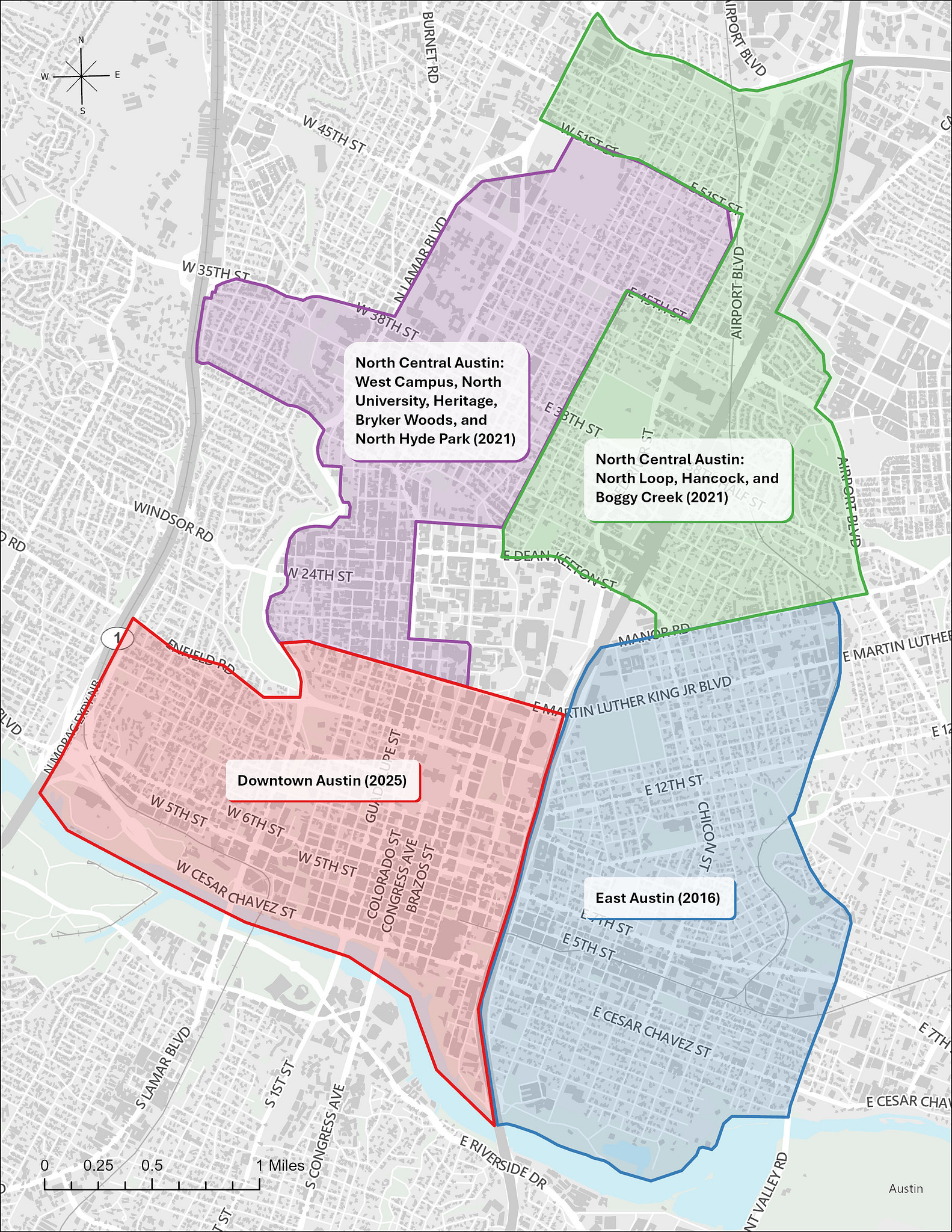
Historic resource surveys typically focus on one geographical area at a time, surveying every older building to determine eligibility for historic designation. View past survey reports in the Past Surveys section below. These reports contain summaries of surveyed resources, research on the historic context of the area, and eligibility recommendations for potential landmarks and historic districts.
In-Progress Surveys
The East Austin Historic Resource Survey Update highlights East Austin's rich history by evaluating 45+ year-old buildings as potential historic landmarks and historic districts. Learn more and get involved!
Past Surveys
- Downtown Austin (2025)
The Downtown Austin Historic Resource Survey aims to capture downtown's rich history by evaluating 45+ year-old buildings as potential historic landmarks and historic districts. It is a planning tool only and does not include zoning changes, land use changes, or property tax adjustments.
- Documenting Austin's Past: Through detailed fieldwork, research in historical archives, and community outreach, the survey aims to create a comprehensive record of downtown's rich built heritage.
- Supporting Heritage Tourism: The survey will identify key historic buildings and districts that could help draw more heritage tourists in Austin. The project is funded by the City's Historic Preservation Fund.
The survey was completed on July 2025.
The files are organized into the following categories:
- Survey Report: Analyzes the main findings of the Downtown Austin Historic Resource Survey.
- Appendix A: Maps: Outlines the recommended historic district boundaries.
- Appendix B: Inventory of Resourced Buildings: Summarizes the data collected for each building surveyed.
- Appendix C: Individual Survey Forms: Includes detailed information about buildings constructed before 1975.
- Appendix D: Historic District Survey Forms: Offers detailed information about each recommended historic district.
- Appendix E: Prior Community Input: Includes summaries and feedback from previous community engagement efforts.
- Appendix F: Photo Contact Sheets: Displays photographs of buildings and sites surveyed during fieldwork.
- Appendix G: Property Taxes and Architectural Styles: Describes property types and architectural styles found in the survey area.
- Appendix H: Fieldwork Methodology and Research Design: Explains the methodology used in conducting the survey and the research design process.
- North Central Austin: West Campus, North University, Heritage, Bryker Woods, and North Hyde Park (2021)
The Historic Building Survey Report for North Central Austin: West Campus, North University, Heritage, Bryker Woods, and North Hyde Park provides eligibility recommendations for federal and local designations for buildings, structures, sites, and objects in these neighborhoods built in or before 1974. Funded by the City’s Historic Preservation Fund, the survey also identifies properties that may promote heritage tourism in Austin.
To research individual properties, please see Appendix B for an inventory by street address and Appendix C for survey forms. Refer to Appendix D for more information on properties identified as eligible for landmark designation, and to Appendix E for information on recommended historic districts.
- North Central Austin: North Loop, Hancock, Boggy Creek (2021)
The Historic Resource Survey for North Central Austin: North Loop, Hancock, and Boggy Creek provides eligibility recommendations for federal and local designations for buildings, structures, sites, and objects (broadly
described as “resources”) in these neighborhoods built in or before 1973.- Survey report
- Appendix A – Public Engagement Documentation
- Appendix B – Architecture Context
- Appendix C – Neighborhood Packets
- C1. North Loop Planning Area
- C2. Upper Boggy Creek Planning Area
- C3. Hancock Planning Area
- Appendix D – Survey Forms
- D1. North Loop
- D2. Upper Boggy Creek
- D3. Hancock
- Old Austin Neighborhood Association (West Downtown, 2020)
The Historic Resources Survey for Old Austin Neighborhood Association covers an area bound by Lamar Boulevard to the west, W. 15th Street to the north, Colorado Street to the east, and W. 4th and 5th streets to the south. The survey was sponsored by the neighborhood association and funded in part by a Certified Local Government Grant from the National Park Service, as administered by the Texas Historical Commission. The report provides eligibility recommendations for federal and local designations for buildings, structures, sites, and objects built in or before 1974.
To research individual properties, please see Appendix C for survey forms.
- East Austin (2016)
The East Austin Historic Survey area is bound by IH-35 on the west, Manor Road on the north, Pleasant Valley Road and the MetroRail line to the east, and Lady Bird Lake to the south. The report provides eligibility recommendations for federal and local designations for buildings, structures, sites, and objects built in or before 1970.
To research individual properties, please see Volume III for an inventory by street address. Refer to Volume IV for more information on properties identified as eligible for landmark designation, and to Volume V for information on recommended historic districts.
- Volume I – Survey report, including East Austin historic context and survey results
- Volume II – Citywide historic context
- Volume III:
- KMZ (Google Earth) files of survey area
- Inventory by street address
- Volume IV – Landmark recommendations
- Volume V:
- Historic district recommendations
- Photo contact sheets
- Future survey recommendations
- Preservation resources