

Meet OSCAR and CLARA
Austin Water is piloting an integrated on-site blackwater reuse facility at the City of Austin's Permitting and Development Center (PDC) to advance decentralized reuse goals in Austin Water's 100-year Water Forward Plan.
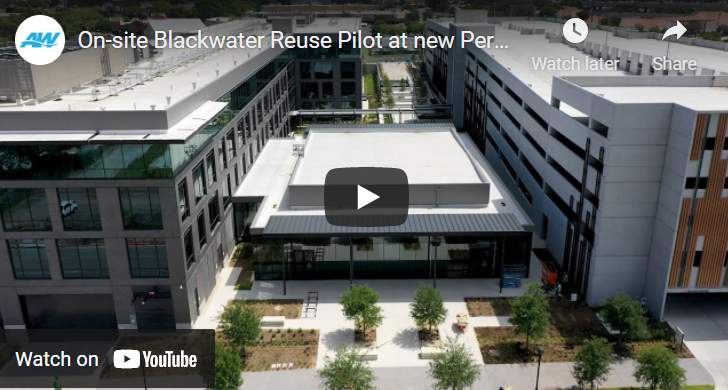
We named the reuse systems to help explain how they work:
- OSCAR (On-Site Collection and Reuse) is an underground 40,000-gallon collection and reuse system that captures rainwater from the building's roofs and condensate water from its heating, ventilation and air-conditioning system. The collected water requires only basic filtration to remove particles and debris before use in outdoor landscaping. This fit-for-purpose approach saves energy because rainwater and condensate need very little treatment for irrigation use.
- CLARA (Closed-Loop Advanced Reclaimed Assembly) can treat up to 5,000 gallons of wastewater per day from the building's sinks, toilets and drinking fountains. Rather than sending that wastewater to a distant treatment plant, CLARA uses an innovative on-site system to turn blackwater into water clean enough to reuse in the building's toilets and urinals. CLARA is a hybrid membrane system with six stages of biological, physical and chemical treatment. The treated water circulates continuously in a closed-loop recycling system.
Benefits
This first-of-its-kind project in Texas will generate performance data to inform future development projects and encourage on-site capture and reuse of non-potable water sources. The project is expected to save nearly 1.5 million gallons of drinking water annually and reduce the site's potable water use by 75%. More effective on-site water management advances Austin's conservation and reuse goals and helps extend core water supplies from the Colorado River and Highland Lakes.
Project Status
Both OSCAR and CLARA have been operational since May 2022. The public is welcome to visit the Permitting and Development Center to learn about the reuse systems through a self-guided courtyard tour or a scheduled guided tour. Email AW_OnsiteReuse@austintexas.gov to schedule a guided tour.
- About CLARA
What CLARA Does and Why
CLARA collects up to 5,000 gallons per day of wastewater from the building's sewers, treats it using advanced membrane technology and recycles the clean water back to flush toilets and urinals. The water can be reused repeatedly for this purpose.
Austin Water piloted CLARA as a demonstration project to encourage new developments to implement on-site reuse, supporting the conservation strategies in the Water Forward Plan. For a detailed description of the treatment process, see the OSCAR and CLARA case study (PDF).
Cost
The cost to design and construct CLARA was approximately $1.7 million, not including operation and maintenance costs.
How CLARA Works
The building is dual-plumbed with separate potable and non-potable piping systems. Potable water is piped to drinking fountains and sinks. CLARA's treated non-potable water is piped separately to toilets and urinals. Non-potable pipes are colored purple for easy identification, and signs are posted wherever non-potable water is in use.
A potable makeup water supply is available for CLARA if the treatment system needs to go offline for maintenance. Cross-connection and backflow prevention measures keep the two systems separate at all times.
Once wastewater enters the pre-anoxic chamber, CLARA takes approximately 32 hours to complete treatment and make water available for toilet flushing. CLARA occupies approximately 800 square feet.
Water Quality and Safety
CLARA is designed and regulated under Title 30 Texas Administrative Code, Chapter 210 for Type I reuse, which permits use for toilet and urinal flushing. Monitoring requirements ensure water quality standards are met on an ongoing basis. The minimum sampling frequency for Type I reclaimed water is twice per week. As a pilot system, Austin Water operators initially collect samples daily for additional data on treatment capabilities and operational requirements.
The building's drinking water fountains and sink faucets are supplied entirely by Austin Water's potable water system and are safe to drink from. Austin Water monitors both systems regularly to prevent any cross-connection between potable and non-potable supplies.
Odor Control and Overflow
CLARA is designed with an odor control system that uses an in-line fan to draw air and gases from the headspace of the bioreactors and trash tanks. That air passes through activated carbon, which removes odorous compounds before discharge.
If a backup occurs in the treatment system, overflow piping directs wastewater to the City's sewer mains — not into pedestrian areas.
Lessons From the Pilot
As the first project of its kind in Austin, in-person coordination with City staff was essential to explain the project's purpose and navigate the development review process. The experience led to a City policy change requiring backflow prevention plans to be submitted earlier in the development review process, reducing construction and occupancy disruptions. Early consultation with Austin Water's backflow prevention group also resulted in a dye injection system that allows cross-connection testing without draining the building's water lines.
CLARA Design and Construction Team
Design
- Technology integrator: Sustainable Water
- Architect: Gensler
- MEP: EEA Consulting Engineers
- Process engineer: Aqua-Nova Engineering
Manufacturing
- Equipment supplier: H2O Innovation, Suez Water
Installation
- Design builder: Ryan Companies
Operations and Maintenance
CLARA is operated and maintained by Austin Water's certified wastewater treatment plant operators, who receive special training from the design engineer and manufacturer at commissioning. The design engineer provides an operations and maintenance manual covering safety, equipment use and controls, recommended maintenance schedules, troubleshooting and process optimization.
- About OSCAR
What OSCAR Does and Why
OSCAR is a rainwater harvesting and air-conditioning condensate collection system with a storage capacity of 40,000 gallons. The collected water is filtered and stored in tanks for outdoor landscape irrigation.
OSCAR collects rainwater and A/C condensate to meet the building's non-potable irrigation demand. This fit-for-purpose approach conserves drinking water, saves energy and draws on a locally available water source. For more on the treatment process, see the OSCAR and CLARA case study (PDF).
Project Cost
The cost to design and construct OSCAR was approximately $625,000, not including operation and maintenance costs.
Why Both Rainwater and A/C Condensate?
Central Texas weather alternates between extended dry periods and short bursts of intense rainfall. Without large and costly storage infrastructure, rainwater may not be available when needed most. A/C condensate is a readily available on-site source that produces high volumes in summer — when rainfall may be scarce and irrigation demand is highest. Both sources need minimal treatment for outdoor irrigation, making condensate an effective complement to rainwater for a continuous on-site supply.
OSCAR Design and Construction
OSCAR is a RainFlo Collection System with Graf XXL filters, installed by Ryan Companies as part of the overall PDC project.
Operations and Maintenance
OSCAR is operated and maintained by a third-party facility management contractor. Maintenance needs are minimal and include basic clearing of leaves and debris from filters and gutters and occasional pump maintenance.
- Resources