
Lake Austin

About Lake Austin
A Source of Drinking Water
Lake Austin is a reservoir, one of the seven Highland Lakes, created by dams on the Colorado River. Lake Austin is relatively small and narrow, sitting between Lake Travis and Lady Bird Lake. It is a pass-through lake, meaning it does not have extra capacity to store floodwaters. It is maintained with a constant water level. It is a major source of drinking water for the City of Austin.
Hydrilla Information
Vegetation on Lake Austin
Texas Parks and Wildlife conducted a survey of vegetation in Lake Austin in September. They identified 575 acres of hydrilla and 99 acres of Eurasian watermilfoil as well as small areas of native vegetation.
Hydrilla coverage has remained stable since June, with some changes in where it is growing. Eurasian watermilfoil has increased from 76 acres.
Green algae, which is commonly found in our waterways, is growing with the hydrilla in several locations. There are small patches of desirable native plants such as eelgrass, coontail, and American lotus.
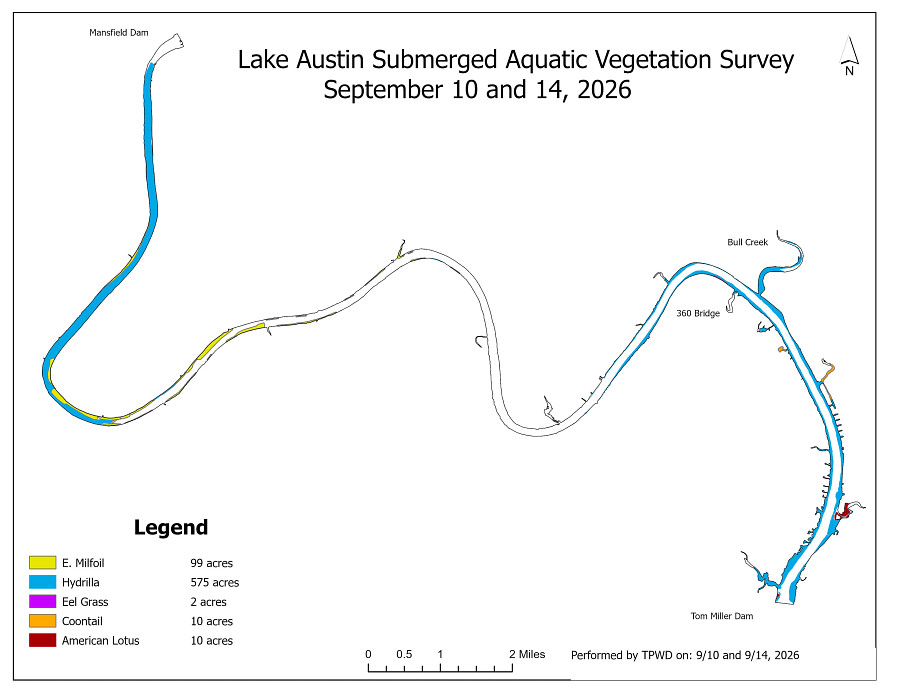
The map shows hydrilla has remained dominant in the upper parts of the lake. The modest floodgate release from Mansfield Dam in July did not significantly reduce coverage.
The middle portion of the reservoir, from Commons Ford Park to Emma Long Metropolitan Park, generally has much less hydrilla but there are patches of Eurasian watermilfoil along sections of the banks.
Hydrilla increased slightly along the shoreline approaching Ski Shores Marina. Bull Creek was nearly completely covered with hydrilla, although a cut channel allowed boats to pass.
In Bee Creek Cove near Tom Miller Dam, hydrilla reached the water’s surface throughout the cove and covered a larger area than it did a year ago.
Why is Hydrilla a Problem?
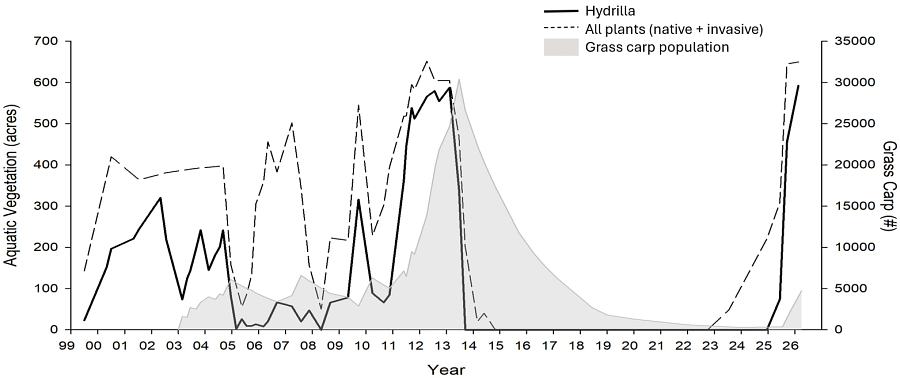
From 1999 to 2003, hydrilla was able to cover about an eighth of the lake. We saw an even more rapid spread in the summer of 2025.
Once hydrilla covers large areas of the lake, it can cause problems for both the environment and our community. Hydrilla may form dense mats that can clog waterways. Dense mats of hydrilla can also impede boats. Hydrilla can out-compete our native vegetation.
Sterile Grass Carp
What is the City Doing?
In optimal quantities, all aquatic vegetation, including hydrilla, provides environmental benefits:
It improves the water quality of the source of our drinking water
It provides oxygen for fish and other aquatic life
It creates habitat and improves food availability for fish
It clarifies the water, uses up excess nutrients, and absorbs other pollutants
However, it can grow so dense that it becomes a problem for the environment and the community. Managing hydrilla responsibly is a long-term effort.
Sterile grass carp have been introduced as an environmentally friendly hydrilla management tool because they prefer to eat hydrilla over other aquatic plants.
Watershed Protection has developed a new predictive model using 25 years of Lake Austin data to guide grass carp stocking decisions. This model will help us compare stocking options over time and under different lake conditions. The goal is to reduce dense hydrilla growth while keeping enough aquatic plants to support a healthy lake.
After each vegetation survey, the City will compare observed conditions with the model’s predictions and update stocking plans as needed. This allows stocking decisions to respond to changes in the lake instead of relying on a fixed number of fish per acre of hydrilla.
The model indicates that adding approximately 7,000 grass carp in the fall of 2026 should set us on a path to see a reduction in the extent of hydrilla. However, the model shows a wide variation in how much time it might take to get within our target of 10 to 30 percent vegetation coverage due to the significant impact that environmental factors outside of our control have on the vegetation.
The stockings since June of 2025 appear to have stopped the increase of hydrilla. However, the model indicates that the current carp population and adding less than 7,000 grass carp would be insufficient to bring the extent of hydrilla back down to an acceptable range.
After the planned stocking this fall, the total population in the lake will still be only one third of the peak population in 2013 that caused all vegetation to be consumed. We anticipate easing the population back down as hydrilla recedes.
| Timeframe | Number of Grass Carp Added |
|---|---|
| July 2025 | 358 |
| November 2025 | 1,995 |
| May 2026 | 2,790 |
| Fall 2026 (Planned) | 7,091 |
Why Are Other Options Limited?
Historically, drawdowns on Lake Austin were done in winter. LCRA guidance now does not allow drawdowns on the Highland Lakes during winter or summer because of the need to maintain reliable hydroelectric power generation during those months. Lowering the lake in the spring would harm fish because they spawn in shallow water during the spring. Spring storms can also create safety and erosion risks when the lake bed is exposed. The root systems of hydrilla survive lake drawdowns, and the plant may bounce back within a short time.
Herbicides are not allowed for use in Lake Austin. While some other Texas lakes use aquatic herbicides, Lake Austin is a relatively small, narrow reservoir with dense residential shoreline development and supplies two of Austin’s major drinking water treatment plants, in addition to other smaller-scale water treatment plants in the area, and some private shoreline residences. Chemicals placed in one area can move downstream and be drawn into public drinking water intakes and/or private intakes for potable and landscaping uses.
Mechanical removal is the recommended method for shoreline homeowners to get temporary, localized relief. Mechanical removal on a lake-wide scale is not feasible due to the speed at which hydrilla grows and its ability to regrow from small pieces.
If manually removing or raking hydrilla from your shoreline, make sure it is properly disposed of or composted.
Historical Information
A Balancing Act
Managing hydrilla with sterile grass carp is a complicated balancing act that takes time. Grass carp generally live for 10 to 20 years, but some may live longer. They prefer to eat hydrilla over other vegetation.
On one hand, it takes time for them to eat enough hydrilla to have a visible impact. On the other hand, there needs to be enough food for them for their whole lifecycle. We do not expect to see immediate reductions in the amount of hydrilla after the grass carp are stocked. However, we expect to make sustained progress on managing hydrilla over time.
Past experience shows that environmental conditions can also have a significant impact on the spread of hydrilla. Droughts create conditions favorable to hydrilla. During the drought from 2010 to 2013, it seemed like we couldn’t stock enough grass carp to keep hydrilla under control. But once the drought ended, the grass carp were still around. Beginning around 2014, all aquatic vegetation began disappearing from the lake, eaten by hungry grass carp. It has taken about 10 years for the lake to recover and reach target levels of aquatic vegetation.
Environmental factors may have contributed to the rapid spread of hydrilla in 2025. We think it may be a combination of flooding and drought. The July floods may have brought in more sediments and nutrients. But, since the floodwaters were stored in upstream lakes, flows through Lake Austin were not fast enough to uproot the hydrilla as previous floods have done. The added nutrients from the July floods may have combined with warm waters and low flows to create the perfect growing conditions for hydrilla. Rain from a number of smaller storms may also have washed fertilizers from shoreline lawns into the lake.
Past experiences underlines the importance of proceeding with caution and giving the lake environment time to adjust to changing conditions. Our goal is to avoid harming wildlife habitat or water quality to ensure a healthy lake for the environment and the community.
This graph compares the amount of vegetation in Lake Austin, the number of sterile grass carp stocked in the lake, and periods of drought.
Properties on the Lake
Fertilizers used on lawns and gardens may be washed into the lake when it rains and contribute to the growth of hydrilla. Consider reducing the use of fertilizers on lawns. In addition, creating a landscaped area with native and adapted plants along the shoreline may help. The plants act as a buffer and help prevent nutrients and other pollutants from entering the lake.
If you are struggling with hydrilla near your property, consider hiring a contractor to clear the hydrilla around docks. The contractor should have a permit from the Texas Parks and Wildlife Department to perform this work.
- Get information about sustainable landscaping at GrowGreen
- Get information about nuisance aquatic vegetation from Texas Parks and Wildlife
How Can I Help?
In addition to avoiding the use of fertilizers, residents and visitors can take the following steps to help prevent the spread of non-native species, like hydrilla:
- Clean, drain, and dry your boat, trailer, and gear before and after use;
- Avoid swimming and boating through dense patches of underwater vegetation;
- If manually removing or raking hydrilla from your shoreline, make sure it is properly disposed of or composted.
Lake Austin Stakeholder Group
We have formed the Lake Austin Stakeholder Group to provide community-informed input on the stewardship and management of Lake Austin. The group brings together representatives from a variety of interests that will meet quarterly to help inform decisions that impact the lake and surrounding community.
Current Community Members Include: Alan Bell, Tara Carr, Jonathan Coon, David Goodman, Lea Holubec, Bobby Levinski, Steve Mangelia, John Messenger, Marina Weikel Ramirez, Janis Smith, Eric Moreland, and Rick Youman
If you would like to share information with or have questions for the Lake Austin Stakeholder Group, please email it to Austin Watershed Protection and it will be shared with the group.
Stakeholder Meeting Summaries
- Meeting 5: September 22, 2026
The Stakeholder Group reconvened, again joined by two business representatives. City staff summarized the preferences that they had heard from the group and discussed next steps.
The group continued discussing how drawdown timing would affect different stakeholder groups. The City confirmed that LCRA continues to reinforce that a January/February timeframe is not an option. This is due to the importance of maintaining generation reliability and capacity during the winter season.
Following the meeting, members had a chance to revise and clarify their preferences. There was no clear consensus with about half preferring to either reschedule the drawdown to December 1 to January 15 and the other half preferring to cancel. No one expressed a preference to keep the drawdown as currently scheduled.
- Meeting 4: September 18, 2026
The Stakeholder Group, joined by two Lake Austin business owners, discussed three potential options for the 2026 drawdown: the original October 12 to November 30 schedule, a new December 1 to January 15 schedule, or canceling the 2026 drawdown and continuing discussions.
The group discussed the potential economic impacts associated with drawdown timing and impacts to businesses, tourism and recreation, previously scheduled weddings and events, and homeowners who have already secured permits and contracts in preparation for the drawdown.
The group emphasized the desirability of a January/February drawdown and asked for a better explanation of why that was not possible. They asked that the City request the LCRA to provide information on the costs and impacts of shifting the drawdown to a January/February timeframe.
The City asked the group to submit a preference on the three options. This was needed to help inform City decision making regarding the timing and options. The City planned to cancel the drawdown if there was not a consensus.
- Meeting 3: September 8, 2026
The third meeting of the Lake Austin Stakeholder Group was structured as an open discussion about the drawdown. It took place the day before the public open house. Stakeholders expressed concerns about the impacts of the drawdown to local businesses, recreation, and tourism. Questions focused on:
The amount of hydropower generated from Tom Miller Dam
The generation capacity of the Texas power grid
Whether replacement power could be purchased,
Whether the drawdown could be delayed to winter months.
Some stakeholders expressed concerns about conducting a drawdown in the winter, if it was possible. Others noted that permits, contracts, and maintenance schedules limited flexibility. Stakeholders noted that a drawdown in the warmer months would be beneficial for the native vegetation and that 2027 may be a better year when it is not El Nino and less rain is anticipated.
Stakeholders requested additional vegetation data. The City noted that the Texas Parks and Wildlife Department has a vegetation survey planned for the fall. Participants expressed frustration that an August meeting was not held.
Stakeholders requested that the City request the LCRA to consider offering winter drawdown dates and provide replacement power cost estimates. They also requested a meeting with the City Manager and LCRA to discuss financial impacts and potential schedule adjustments.
- Meeting 2: June 25, 2026
The second Lake Austin Stakeholder Meeting focused on the potential lake drawdown. Updates were provided on the drawdown decision process, including identifying associated costs, permitting considerations, and the coordination required among agencies before a final decision can be made. Additional discussion centered on hydrilla management, the June vegetation survey findings, algae monitoring, and the potential benefits and drawbacks of a drawdown for shoreline maintenance and aquatic vegetation control.
Participants discussed concerns about navigation, wake surfing, vegetation impacts, and public safety. They also had questions about the drawdown, including expedited permitting, funding opportunities, public access impacts, and the timeline.
An update on the drawdown is expected by early August. Potential topics for the next meeting include further discussion of the drawdown and wake surfing and wake boarding safety.
- Meeting 1: May 6, 2026
The meeting included a discussion of Stakeholder Group goals focusing on establishing a transparent, data-driven framework for lake management that prioritizes both safety and proactive hydrilla control. Members emphasized the need for long-term hydrilla management solutions that protect the environment, community, and high-quality bass habitats while integrating public education strategies.
Significant discussion centered on the process and logistics of lake drawdowns and the hydrilla overgrowth. Stakeholders expressed desire for a timeline that expedites a drawdown decision in June to provide time for permitting and community outreach before a potential drawdown in October and November. The group is interested in more inter-agency participation during stakeholder group meetings with entities like the LCRA, Texas Parks and Wildlife Department, and Austin Development Services.
An update on the latest release of additional grass carp was shared, which continues to be the primary long-term maintenance strategy. Herbicide use is not recommended due to several concerns.
At the next meeting, planned discussion items include information from Austin Development Services on expedited permit processes for repairs to private docks and bulkheads prior to a drawdown, an update on decision-making on a potential drawdown in October and November 2026, and further discussion of the process.
More Information
We monitor the water quality in our lakes and creeks in order to understand how the urban environment affects our water bodies and to develop effective policies to protect them.
The State of Our Environment Report includes the most recent monitoring data for our lakes, creeks and aquifers.
Real-time river and lake conditions, weather radar and more.
We monitor the water quality in our lakes and creeks in order to understand how the urban environment affects our water bodies and to develop effective policies to protect them.
The State of Our Environment Report includes the most recent monitoring data for our lakes, creeks and aquifers.
Real-time river and lake conditions, weather radar and more.
Our creeks and lakes are home to an amazing number of trees, birds, fish, and other wildlife.
Austin’s waterways are home to many different types of algae that play important roles in the natural world.
LCRA produces electric power, manages the lower Colorado River, provides water, manages a public parks system and supports community development.