
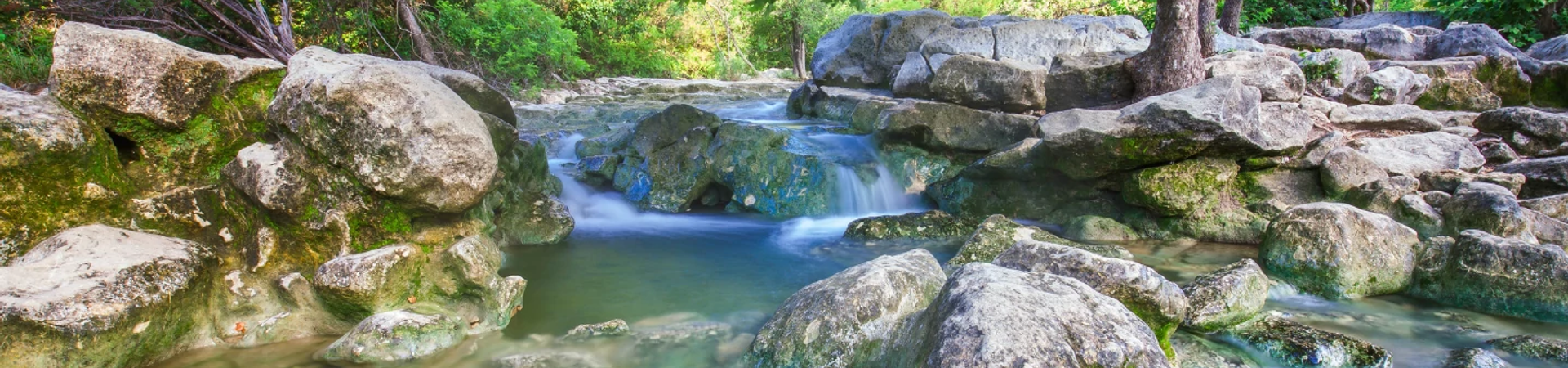
Plant Life in Austin's Lakes
Austin Watershed Protection helps monitor plant life along our lakes. We encourage native plants and try to manage invasive plants that disrupt the food web. Our creeks and lakes are home to an amazing number of trees, birds, fish, and other wildlife. Whether plants are underneath the water, floating on the surface, or growing along the banks, they play a key role in supporting this environment. Plants provide food as well as places to hide, hunt, and spawn. They contribute to improved water quality conditions. Watch Aquatic Plants of Lady Bird Lake.
Aggressive Plants
Lake Austin, Lady Bird Lake, and Lake Walter E. Long are man-made reservoirs, which means they function differently than a "natural" lake. Invasive plants can hinder these lakes from functioning properly.
- Elephant Ear
Elephant ear (Colocasia esculenta) is not native to central Texas. It is from the Asian tropics. It has been in Central Texas since at least 1929. On Lady Bird Lake, it is especially common on the north shore, where it gets lots of sun. It likes to keep its feet wet right at the water’s edge. It can grow so densely that it prevents other plants from getting established. This reduces the diversity and resilience of the shoreline habitat and impacts large water birds such as herons and egrets.
The shallow roots of small elephant ear plants are easily uprooted in floods. This helps it spread downstream and start new colonies.
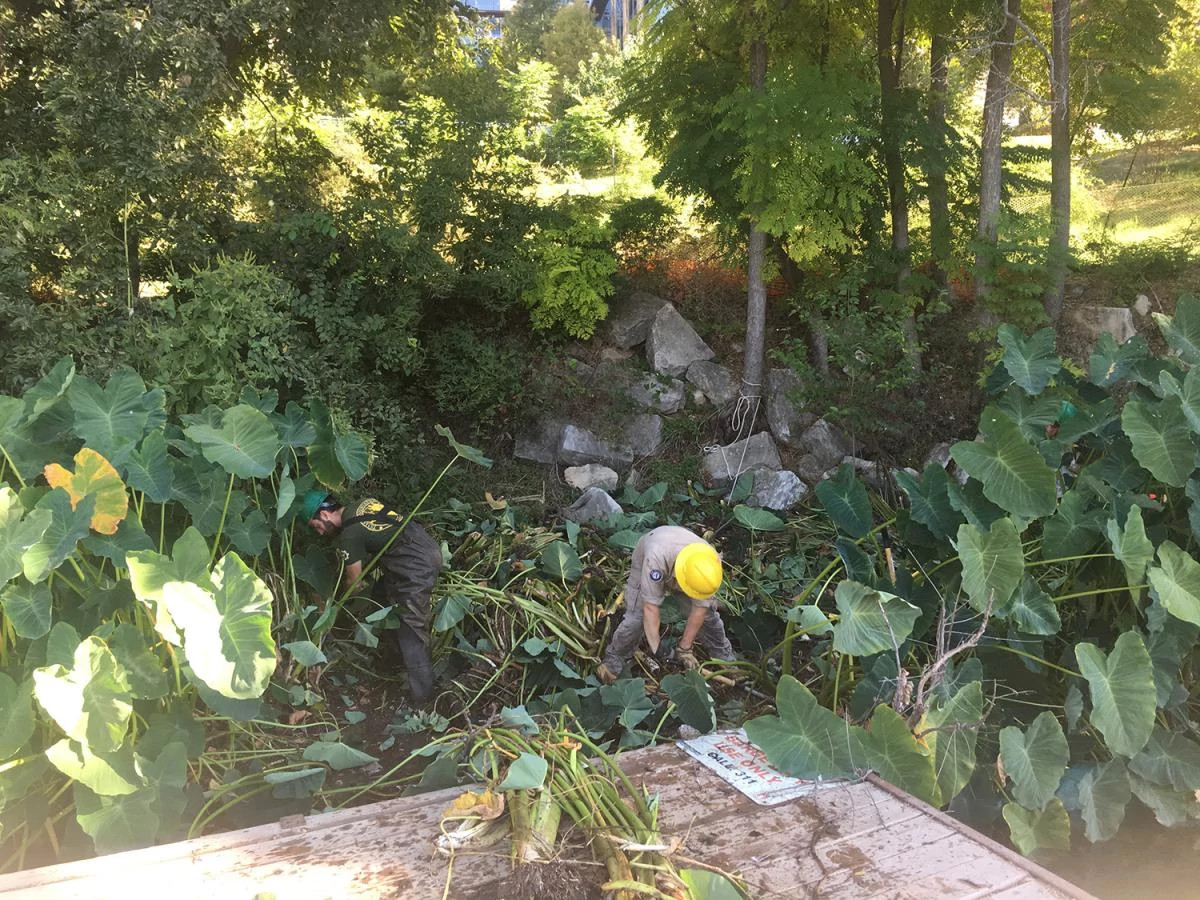
Rather than trying to eradicate elephant ear altogether, we try to manage the population so that elephant ear does not dominate the shoreline. In partnership with American Youthworks and the Trail Conservancy, we have removed the large patches of elephant ear and planted native grasses, sedges and wildflowers in its place. We sometimes treat elephant ear with an EPA-approved herbicide.
- Eurasian Watermilfoil
Eurasian watermilfoil (Myriophyllum spicatum) is also a non-native aquatic plant that is commonly found in both Lake Austin and Lady Bird Lake. In both lakes the plant tends to be most dense in the upper reaches, where water temperatures are cooler. This aquatic plant is native to eastern Europe and Asia but has been in the Austin region for over five decades. Like hydrilla, milfoil can rapidly spread by fragmentation and can form dense rafts where conditions are suitable. Treatment and removal procedures and considerations are the same as with hydrilla. Please see the recommendations for hydrilla on this page.
The Austin-region does also support a native milfoil, Parrot’s feather (Myriophyllum aquaticum), but it’s distribution and growth are very limited in the lakes.
- Fanwort in Lady Bird Lake
Fanwort (Cabomba caroliniana) is a native aquatic plant that grows in Lady Bird Lake. It has delicate white flowers that often bloom underwater. Fanwort provides oxygen, food and hiding places for fish, turtle, birds, and other aquatic life. It helps filter pollutants from the water and may prevent other, less desirable vegetation from spreading in the lake.
Because fanwort can spread quickly over large areas of the lake, it is disliked by some recreational users. However, we generally avoid actively managing the plant since it is beneficial for aquatic life and has a natural life cycle. The plant tends to be uprooted and dispersed by large flow events after large storms.
Austin residents and business owners along the lake may get a free permit from Texas Parks and Wildlife to remove nuisance vegetation from around their docks.
Visit Texas Parks and Wildlife's page on Nuisance Aquatic Vegetation
- Giant Reed
Giant reed (Arundo donax) is a member of the grass family that grows up to 20 feet tall, with deep, dense roots. Flowers are long plumes, one to two feet long, and appear in August and September. Giant reed spreads quickly by fragments and roots.
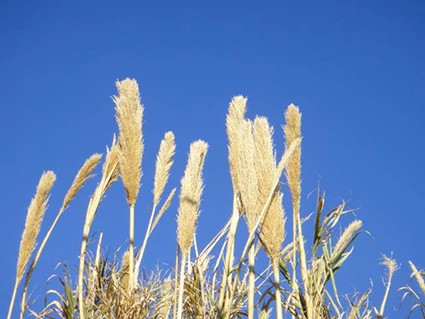
It can form dense stands along the shoreline of Lady Bird Lake and along creek channels. It can choke out other plants, limit access to the lake, interfere with flood control and increase fire potential.
In the past, before years-long removal efforts, giant reed was most abundant near Red Bud Isle, the mouths of Barton and Waller Creeks, and downstream of IH-35. It grew on steep slopes between the lake and the Ann and Roy Butler Hike and Bike Trail. However, stands of the plant can be found along numerous creeks as well as Lake Austin’s shorelines.
Removal is challenging. Elimination includes cutting the plants down and then treating them with a herbicide. Sometimes, we needed to re-treat a single stand for multiple years. Following removal of a stand, we have worked with the Trail Conservancy to restore the area impacted and encouraged native plants.
- Hydrilla in Lake Austin
Hydrilla
Hydrilla (Hydrilla verticillata) is a non-native, invasive plant that was first observed in Lake Austin in 1999. We have learned much since that time about the challenges of managing this plant.
There has been a spike in the extent of hydrilla in Lake Austin since June 2025. Hydrilla is a nonnative, invasive plant. In February, it was covering approximately 592 acres, up from 456 acres in September. We have stocked an additional 2,790 sterile grass carp into Lake Austin in early May to help manage hydrilla. They were released near Tom Miller and Mansfield Dams. This brought the population of grass carp in Lake Austin from about 5 to 8 fish per acre of hydrilla.
When considering hydrilla, please keep in mind:
- Aquatic vegetation, including hydrilla, can benefit fish and water quality
- Hydrilla can grow so fast that it becomes a problem for the environment and our community.
- Managing hydrilla is a complicated balancing act that takes time.
Learn more about hydrilla on our Lake Austin page.
Habitat Restoration on Lake Austin
Changes to plant life can have a negative impact on the food web. Loss of habitat can occur through removal of vegetation, growth of invasive species, or natural causes such as storms
We have tried different ways to restore habitat in Lake Austin. In coordination with the University of North Texas, we established founder colonies of aquatic vegetation within temporary cages. Cages protect the desired vegetation from ducks, turtles, grass carp, and other plant-eaters. The hope was that caged plants will spread naturally throughout the lake. However, after years of effort, we have observed that the rapid growth rates of non-native hydrilla and Eurasian watermilfoil tend to exceed those of native vegetation.
Together with Texas Parks and Wildlife, the Texas Tournament Zone and volunteers, we have also sunk evergreen trees into deep water. This imitates the natural process when trees along the shoreline die. The trees stimulate the entire food web. First, bacteria begin to grow along the green tree leaves. The bacteria, in turn, become food for invertebrates and small grazing fish. Fish, both small and large, live among the submerged tree branches, hiding and hunting each other. Essentially, the tree becomes a buffet line for all the residents of the lake!
Research and Publications
Visit our publications database.
- Hydrilla management impacts on a largemouth bass fishery: A case for a balanced management approach, 2024,Journal of the Southeastern Associated of Fish and Wildlife Agencies 11: 14 – 22.
You can help!
- Avoid planting invasive species at home. GrowGreen recommends native and adapted plants for the Austin area. Visit GrowGreen.org
- Consider planting pickerel weed (Pontederia), arrowhead (Sagittaria) and powdery thalia (Thalia) in your water garden.
- Volunteer through Keep Austin Beautiful’s Adopt-a-Creek program or the Austin Parks Foundation. City staff consults with creek and park adopters on best management practices for restoring creeks and managing invasive plants.
- The Trail Conservancy hosts volunteer events throughout the year, including invasive plant management, wildflower seeding and tree seedling planting.
- Sign up to be notified about volunteer events co-organized by the Austin Watershed Protection.