

City of Austin
FOR IMMEDIATE RELEASERelease Date: Jan. 07, 2026
AUSTIN, Texas – Austin-Bergstrom International Airport (AUS) today announced the completion of new multi-year Airline Use and Lease Agreements and Signatory Cargo Agreements that have established the financial and operational framework for how passenger airlines and cargo companies will operate at AUS for the next decade. These milestone agreements provide the necessary financial foundation for airport-generated revenue that will support ongoing operations and fund the airport’s major expansion and development, including the construction of 32 new airline gates.
The Airline Use and Lease Agreement and Signatory Cargo Agreement are the primary governing documents between AUS and its airline and cargo partners. The agreements outline major capital projects planned over the next 10 years and define the methodology for calculating rates and charges that support airport operations, maintenance, and long-term investment. The agreements also commit passenger airlines and cargo companies to a 10-year commitment to operating at AUS.
The new agreements—executed by AUS’s signatory airlines and cargo companies, Southwest Airlines, Delta Air Lines, United Airlines, American Airlines, Alaska Airlines, FedEx, and UPS —define the methodology for how airline fees are calculated for airport-owned facilities such as runways, ticket counters, gates, baggage systems, aircraft parking positions, and leased operational spaces. These charges, which represent a significant portion of airport revenue, directly support AUS’s ability to issue and repay airport revenue bonds and other financing that make the expansion program possible.
Airlines and cargo companies that are not signatory will continue to operate under standard industry practice by paying per-use charges for airport facilities. The finalized use-and-lease agreements ensure airlines and cargo companies commit to funding their proportional share of these projects through the rent and fees generated under the agreements’ cost-recovery structure, supporting the airport’s ability to deliver projects that expand capacity, strengthen resiliency, and improve the passenger experience.
Key Projects Supported by the Agreements:
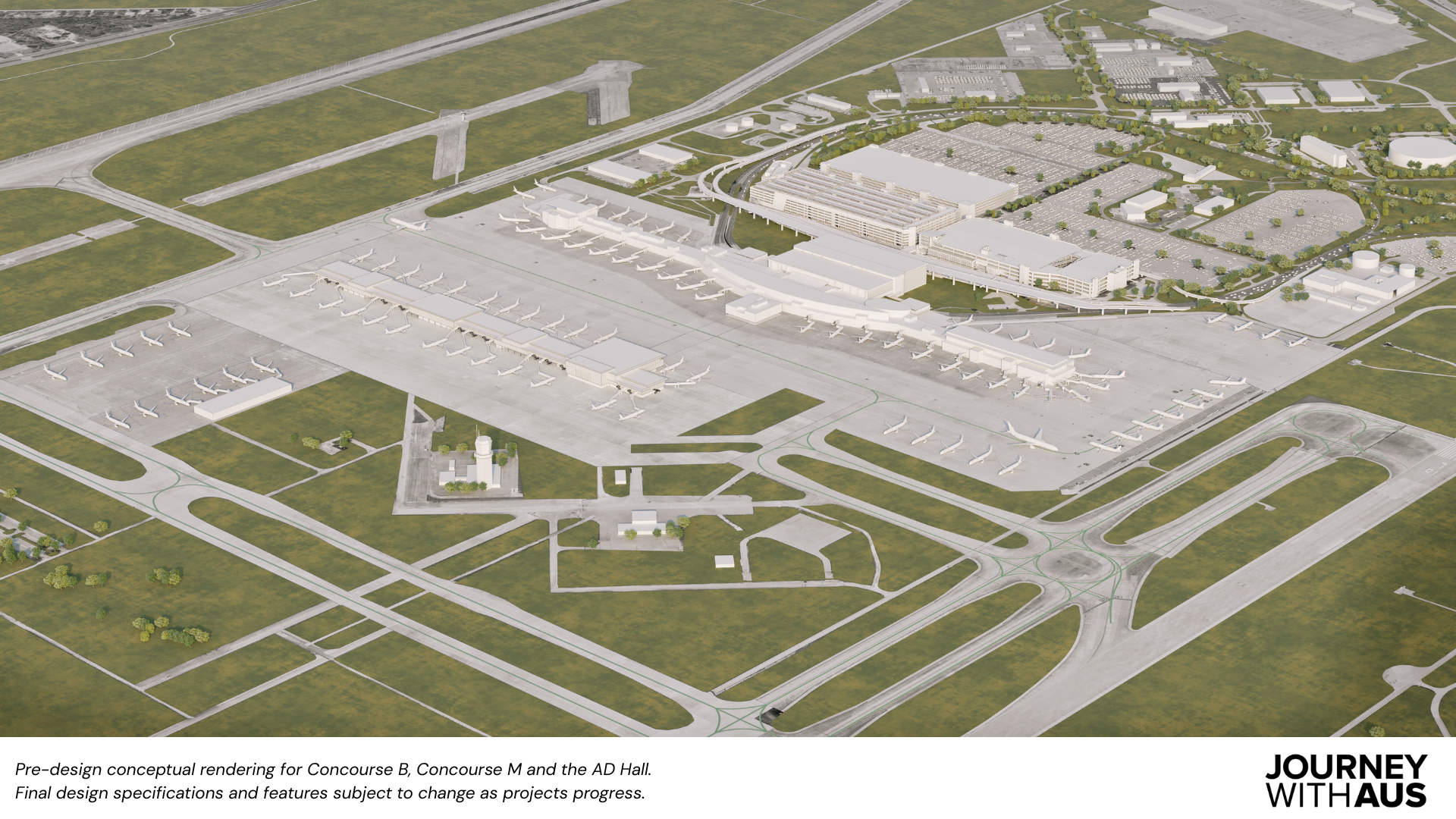
Concourse B
A new concourse with 26 gates, expanded ramp operations, and space designed to support the airport’s long-term passenger growth. Concourse B will be home to non-signatory airlines, Southwest Airlines as the Concourse B anchor tenant with 18 gates, United Airlines with 5 gates, and 3 gates will be available for domestic common use.
New Arrivals and Departures Hall
A transformative project that will modernize the front door of AUS and improve end-to-end passenger flow, including:
- A redesigned curbside experience to reduce congestion and improve passenger and vehicle flow
- A new pedestrian bridge option connecting parking garages and the Rental Car Facility, providing an alternative to crossing terminal traffic at grade.
- A new and expanded baggage claim hall
- A new centralized TSA security checkpoint
- New expanded airline ticket counters
- New airport amenities like concessions, a mobility lounge, and meet and greet area
Concourse M
A new pre-engineered facility that will add 6 new gates to increase airport capacity. Concourse M will support construction phasing, accommodate new airline entrants, and provide operational flexibility for irregular operations, including off-schedule and diverted flights. Features of the new facility include:
- A dedicated bus operation that will transport travelers between the Barbara Jordan Terminal and Concourse M
- 6 gate hold room areas
- Restrooms and passenger amenities
- New concession offerings
Concourse A Redevelopment
The existing concourse, departures hall, ticket counters, and baggage claim in the Barbara Jordan Terminal will be redeveloped to create a modernized, post-security Concourse A with enhanced gate seating, modernized concessions, expanded passenger circulation space, and upgraded and expanded amenities.
Concourse A will be home to all international flights and also non-signatory airlines. Delta Air Lines, as the Concourse A anchor tenant, will have 15 gates, American Airlines will have 9 gates, and Alaska Airlines will have 1 gate. There will be 8 common-use gates that have the capability of being used for both domestic and international flights.
Utility Projects
A critical enabling effort for delivering these expanded facilities—including Concourse B, Concourse M, and the new Arrivals and Departures Hall—is the Utility Infrastructure Campus-Wide and the Central Utility Plant.
These utility projects will upgrade and expand essential heating and cooling capacity as well as key supporting systems, including electrical power, IT/telecommunications, storm drainage, water quality, and deicing infrastructure.
This foundational investment will ensure AUS can reliably support the increased demands of the expanded airport while positioning the campus to accommodate future growth.
Program Funding and Next Steps
As AUS advances the next generation of airport infrastructure, the expansion projects have increased in size and complexity to better meet airline operational needs and accommodate higher passenger demand and projected regional growth.
To align with the increased scope and scale of the expansion program and the planned total airport gate buildouts more than initially planned, Austin Aviation will seek additional spend authority from the Austin City Council for design and construction services. While the final program cost is still under development, staff anticipate the expansion program budget will increase from an estimated $4 billion program (20 gates) to over a $5 billion (32-gate) as scope is refined.
The program, and all associated projects, are funded through traditional airport development funding sources, such as airport cash reserves, current and future airport revenues, future revenue bond proceeds, and Federal Aviation Administration grants. No local Austin taxpayer dollars are used to fund the airport’s expansion program.
Ghizlane Badawi, Chief Executive Officer, Austin-Bergstrom International Airport, said:
“Today marks a historic moment for our airport, our city, and the Central Texas community. This agreement reflects years of partnership, thoughtful negotiations, and shared vision with our airline partners. Their commitment provides the financial foundation we need to modernize our facilities, transform customer experience, and build the infrastructure needed to support Central Texas’ continued growth for generations to come. AUS would not be where it is today without the collaboration and investment of our airlines, and we are deeply grateful for their trust and partnership as we shape the future of air travel in Central Texas.”
Kirk Watson, Mayor, City of Austin, said:
“I’m proud to have been here when this airport first opened, and I’m proud to stand here again as we usher in a new era for aviation in Central Texas. The expansion we commit to today will define the expansion of the future—supporting travelers, strengthening our economy, and preparing Austin for the decades of growth ahead. We are grateful to the airlines for believing in Austin, investing in Austin, and helping us build what comes next.”
Vanessa Fuentes, District 2 Councilmember, City of Austin, said:
“This expansion program represents a tremendous economic opportunity for Austin—not only through the trades and construction jobs created during the buildout, but also through long-term jobs in concessions, airport operations, and airline services after the program is complete. We thank our airline partners for their continued investment in our community and for helping create a stronger, more connected Central Texas.”
For more information about the Journey With AUS Expansion Program and upcoming improvements, visit Austintexas.gov/AUSJourney.